You have 0 items in your cart
You bought a plot of land in Kenya. You paid the deposit, completed the instalments, received an allocation letter or sale agreement, and waited for the developer to process your title deed.
Months passed. Then years.
Whenever you follow up, you receive another explanation. The subdivision is supposedly still being processed. The survey documents are pending. The Land Registry has delayed. The developer promises that titles will be issued soon, but no clear date is provided.
Meanwhile, you cannot confidently sell the land, develop it, use it as security or complete the ownership process you expected when you made the purchase.
If you have paid for land and the developer has failed to issue your title deed, you may have legal remedies. However, the appropriate action depends on the sale agreement, the ownership of the parent land, the status of the subdivision, the developer’s ability to complete the transaction and the circumstances surrounding the delay.
A buyer should not assume that every title delay is simply an administrative problem. Equally, a delay does not automatically prove fraud.
The first step is to establish what has happened to the land and what the developer is legally required to do.
1. Why Developers Fail to Issue Title Deeds in Kenya
There are several reasons why a developer may fail to issue individual title deeds after selling plots to buyers.
Understanding the cause of the delay is important because the legal remedy may differ depending on the underlying problem.
The subdivision has not been completed
A developer may have purchased a large parcel of land and marketed smaller plots before completing the subdivision and registration process.
The plots may have been physically marked on the ground and allocated to buyers, but the resultant parcels may not yet have been registered.
The developer may still be required to obtain approvals, complete survey work, prepare the relevant documents and satisfy the requirements for registration.
If the subdivision process has stalled, buyers need to establish exactly which stages have been completed and which remain outstanding.
The developer has not obtained the required approvals
Subdivision and development may require approvals from relevant authorities depending on the land, location and transaction.
A developer may have sold plots before obtaining the necessary approvals or may have encountered difficulties obtaining them.
Buyers should not rely on verbal assurances that approvals are “being processed.”
Ask for the relevant approval documents and independently verify their status.
The parent title is charged to a bank
Some developers finance land acquisition or development using bank loans secured against the parent title.
If the parent land is charged, the developer may need to address the lender’s interest before individual titles can be issued or transferred.
The buyer may discover that the bank has an interest over the land even though the developer has already sold plots within the development.
This can create serious complications if the developer is unable to discharge the charge, obtain the necessary consent or arrange for the individual plot to be released from the security.
The developer does not own the land
A developer may market plots on land registered in another person’s name.
The developer could be acting under a development agreement, joint venture, lease, power of attorney or another arrangement.
The existence of a commercial relationship does not automatically establish that the developer has the legal authority to sell the plots or complete the transfer.
The buyer should verify the registered proprietor and the developer’s authority.
The land has a dispute
The developer may be involved in a dispute with:
- The registered landowner.
- A bank or other lender.
- Another developer.
- A co-proprietor.
- A previous purchaser.
- A land-buying company.
- A government authority.
A dispute may affect the subdivision, registration, possession or transfer of the property.
The developer has financial difficulties
A developer may have collected substantial amounts from buyers but may be unable to complete the project.
The money may have been used for other projects, loan repayments, operational expenses or other purposes.
If the developer becomes financially distressed, buyers may face delays that are difficult to resolve through ordinary follow-up.
The developer has allocated the same plot to more than one buyer
In some disputes, buyers discover that the same plot has been allocated or sold to multiple people.
This can happen where records are poorly maintained or where a developer engages in fraudulent or improper transactions.
A buyer should investigate immediately if another person claims ownership of the plot or if the developer cannot consistently identify the plot being sold.
2. Is an Allocation Letter Enough to Prove Ownership?
Many land buyers in Kenya receive an allocation letter after making a payment.
An allocation letter may identify the plot, the buyer, the development and the terms under which the plot has been allocated.
However, an allocation letter is not automatically equivalent to a registered title deed.
Its legal significance depends on the underlying transaction and the documents supporting the allocation.
For example, a buyer may have:
- An allocation letter.
- A booking form.
- A sale agreement.
- Payment receipts.
- A plot identification map.
- A possession letter.
- A transfer document.
- Correspondence confirming completion of payment.
These documents may help establish the contractual relationship between the buyer and developer.
However, they do not necessarily establish that the buyer has become the registered proprietor of the land.
The buyer should establish:
- Who owns the parent parcel?
- Is the developer authorised to sell?
- Is the allocated plot identifiable?
- Has the subdivision been approved?
- Has the survey been completed?
- Has the resultant parcel number been issued?
- What steps remain before registration?
- What does the sale agreement require the developer to do?
If you are still at the purchasing stage, read our guide on Buying Land from a Developer in Kenya: What to Check Before Paying for a Plot in an Estate or Gated Community.
It explains the checks buyers should conduct before committing money to a developer-led subdivision.
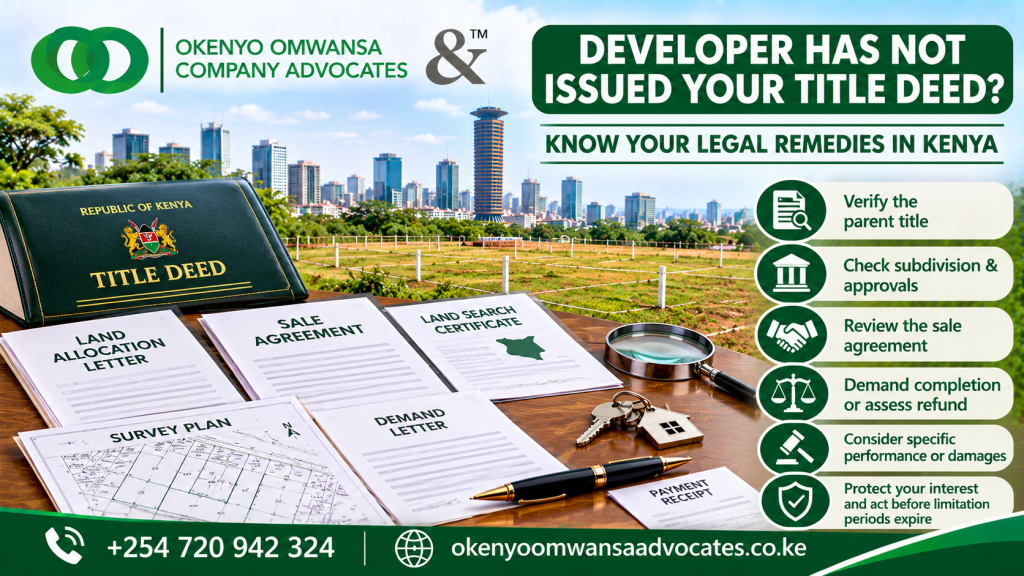
3. Start by Conducting an Independent Legal Investigation
Before sending another demand letter or threatening court action, establish the current legal status of the property.
A buyer may have spent years following up with the developer without knowing that the parent title has been transferred, charged, restricted or affected by another transaction.
An independent legal investigation should examine the underlying land and the developer’s obligations.
A. Obtain the parent title details
Ask for the parcel number of the original land from which your plot was supposed to be created.
Do not rely only on the plot number used by the developer.
The investigation should establish the underlying parcel and the registered proprietor.
B. Conduct an official search
An official search should be conducted against the relevant registered parcel.
Where the parcel is registered on an available digital system, the relevant online process may be used. Where the parcel remains under a manual registry, the appropriate land registry process should be followed.
The search should help establish the current registered ownership and identify registered interests such as charges, cautions, restrictions or other entries.
You can access the Ministry of Lands’ digital platform through Ardhisasa, subject to the availability of the relevant parcel and services on the platform.
C. Investigate the developer’s authority
If the developer is not the registered proprietor, obtain and examine the legal documents establishing the developer’s authority to sell.
These may include:
- A development agreement.
- A joint venture agreement.
- A lease.
- A power of attorney.
- An agreement with the registered landowner.
- Corporate resolutions.
- Other documents authorising the sale or transfer.
The purpose is to establish whether the developer had the legal authority to enter into the transaction and whether that authority remains valid.
D. Check for charges and restrictions
Determine whether the parent title is affected by:
- A bank charge.
- A caution.
- A restriction.
- A court order.
- A prohibition.
- A pending transaction.
- Other registered interests.
If a lender holds a charge over the parent parcel, the investigation should establish how the developer intends to release the plot from the security and facilitate transfer.
E. Establish the status of the subdivision
Obtain the relevant subdivision approval, survey documents and supporting records.
Establish whether:
- Subdivision approval was granted.
- The approval remains valid.
- Survey work has been completed.
- The resultant parcels have been identified.
- Registration has been initiated.
- There are outstanding requirements.
- The proposed plot corresponds with the approved plan.
A buyer should not accept the statement that “the title is being processed” without understanding what that means in practical and legal terms.
For more information about the risks of purchasing property remotely, see our guide on Buying Property in Kenya from Abroad: How to Verify the Title, Seller and Developer Before Sending Money.
4. Review the Sale Agreement and Identify the Developer’s Obligations
Your sale agreement is one of the most important documents in determining what you can do next.
The agreement should be examined to establish exactly what the developer promised and whether those obligations have been breached.
Look for clauses dealing with:
Title issuance
Does the agreement require the developer to issue an individual title deed?
Does it require the developer to transfer an existing parcel?
Does it provide for a title to be issued after subdivision?
Does it identify the documents required to complete the transfer?
Completion date
Was a completion date specified?
Was the title expected within a particular number of months or years?
Was the completion date extended through a subsequent agreement?
Were any conditions attached to the completion date?
Subdivision obligations
Did the developer undertake to obtain subdivision approval?
Was the developer required to complete survey work?
Was the developer required to obtain parcel numbers?
Was the developer responsible for registration and title issuance?
Payment obligations
Have you paid the full purchase price?
Are there any outstanding payments?
Were you required to pay separate fees for survey, transfer, registration or other administrative processes?
Were the amounts paid and acknowledged?
Default provisions
What happens if the developer fails to complete?
Does the agreement provide for a refund?
Does it provide for interest or damages?
Does it permit termination?
Does it specify dispute-resolution procedures?
Does it contain a notice requirement?
Representations and warranties
Did the developer make promises concerning ownership, subdivision approval, infrastructure, title issuance or the legal status of the land?
Were those promises incorporated into the written agreement?
A legal review should identify the obligations that can be enforced and the potential remedies available if the developer has breached them.
5. Send a Formal Demand Letter to the Developer
If the developer has failed to fulfil the contractual obligations, a formal demand may be an appropriate first step.
A demand letter should not merely say:
“Please issue my title deed immediately.”
It should identify the legal and factual issues and require a clear response.
Depending on the circumstances, the letter may:
- Identify the buyer and plot.
- Identify the sale agreement.
- Confirm the payments made.
- State the obligations that remain outstanding.
- Identify the relevant completion or title-issuance deadline.
- Request information about the parent title.
- Request the subdivision and survey documents.
- Request an explanation of the delay.
- Require the developer to provide a realistic completion plan.
- Demand completion within an appropriate period where legally justified.
- Reserve the buyer’s rights under the agreement and applicable law.
The demand should be based on the actual agreement and facts.
It should avoid making allegations of fraud without supporting evidence.
What if the developer ignores the demand?
If the developer does not respond, the buyer should not continue sending informal messages indefinitely.
A failure to respond may justify considering further legal steps, depending on the agreement and the circumstances.
The buyer should preserve copies of all correspondence, delivery records and responses.
A formal demand can help clarify the dispute, but it does not automatically guarantee that the developer will complete the transfer.
6. Can You Sue the Developer for Failing to Issue a Title Deed?
Yes, a buyer may be able to commence legal proceedings where the developer has breached an enforceable agreement or where another legal basis for a claim exists.
However, the appropriate claim and remedy depend on the facts.
The buyer should establish:
- Whether there is a valid written agreement.
- Whether the agreement complies with the applicable legal requirements.
- Whether the developer had authority to sell.
- Whether the buyer performed their contractual obligations.
- Whether the developer has breached the agreement.
- Whether the land can legally be transferred.
- Whether the proposed remedy is available.
- Whether the claim is within the applicable limitation period.
Section 3(3) of the Law of Contract Act generally requires contracts for the disposition of an interest in land to be in writing, signed by the parties and attested as required by law, subject to the applicable statutory provisions.
A buyer should not assume that every informal arrangement, receipt or verbal promise is sufficient to enforce a land sale transaction.
The documents should be reviewed by an advocate before proceedings are commenced.
7. Can the Court Order the Developer to Issue the Title Deed?
In appropriate cases, a buyer may seek an order of specific performance.
Specific performance is a court remedy that requires a party to fulfil contractual obligations rather than simply paying damages.
In a land transaction, a buyer may seek an order requiring the seller or developer to complete the sale and transfer the land in accordance with the agreement.
However, specific performance is not automatic.
The court generally considers whether there is a valid and enforceable contract, whether the party seeking the remedy has performed or is ready and willing to perform their own obligations, whether the land can legally be conveyed and whether specific performance is appropriate in the circumstances.
The court may refuse specific performance where the transaction is defective, illegal, impossible to complete, affected by circumstances that make the remedy inappropriate or where an adequate alternative remedy exists.
What if the developer has already subdivided the land?
If the subdivision has been completed and the plot can be identified and transferred, specific performance may be a possible remedy depending on the transaction.
The buyer’s advocate should investigate the registration status and identify the legal steps required to complete the transfer.
What if the developer has not completed the subdivision?
The court may need to consider whether the developer has the legal and practical ability to complete the required subdivision and transfer.
A buyer should not assume that a court can automatically compel the issuance of a title where the necessary approvals, surveys, registration steps or other legal requirements remain unresolved.
The relief sought must be realistic and supported by the evidence.
What if the developer no longer owns the land?
This may significantly affect the available remedies.
If the land has been transferred to another party, the buyer may need to investigate the circumstances of the transfer, the rights of the third party and whether any legal remedy is available against the developer or other parties.
The appropriate action depends on the facts and the legal status of the land.
8. Can You Demand a Refund Instead of the Title Deed?
Depending on the agreement and the circumstances, a buyer may be entitled to seek a refund of the purchase price or other payments where the transaction cannot be completed or where the contract is lawfully terminated.
The legal basis for a refund may arise from the agreement, the circumstances of the breach, rescission or another applicable legal principle.
Before demanding a refund, the buyer should establish:
- Whether the agreement permits termination.
- Whether the developer has committed a material breach.
- Whether the appropriate notices have been issued.
- Whether the buyer has complied with their own contractual obligations.
- Whether the buyer has a right to rescind or terminate.
- Whether the refund is subject to deductions.
- Whether interest or damages may be claimed.
- Whether the developer is financially capable of refunding the money.
A refund claim may be more practical where the developer cannot legally or practically complete the transfer.
However, terminating the contract without proper legal advice can create complications.
A buyer should not simply declare the agreement cancelled and demand money without examining the legal and contractual requirements.
9. Can You Claim Damages for the Delay?
A buyer may, in appropriate circumstances, seek damages for breach of contract.
However, damages are not automatically payable simply because the title deed has been delayed.
The buyer must establish the relevant breach, the legal basis for the claim and the loss that can properly be recovered.
Depending on the circumstances, the buyer may have suffered losses associated with:
- Inability to develop the land.
- Loss of an intended use.
- Additional expenses.
- A failed onward sale.
- Financing costs.
- Other losses arising from the breach.
The recoverability and assessment of damages depend on the contract, the evidence, causation and applicable legal principles.
A buyer should maintain records of any actual losses and avoid assuming that a court will award compensation for every inconvenience or delay.
10. Can You Register a Caution Against the Land?
A caution may be available where a person has a legally recognisable interest in land and the statutory requirements for registration are satisfied.
A buyer who has entered into a land sale agreement may have an interest that warrants considering a caution, depending on the circumstances and the applicable legal framework.
However, caution registration is not automatic.
The buyer should establish:
- The legal interest relied upon.
- The relevant parcel number.
- Whether the interest is capable of being protected through a caution.
- Whether the registration requirements have been satisfied.
- Whether there are competing interests.
- Whether the caution may affect other transactions.
A caution should not be used as a substitute for resolving the underlying dispute.
Where appropriate, a caution may help protect a claimed interest against certain dealings while the dispute is being addressed, but its effect depends on the law and circumstances.
Your advocate should assess whether registration is appropriate and what steps may be required if the caution is challenged.
11. What If the Developer Has Sold the Same Plot to Another Buyer?
This is a serious situation that requires immediate investigation.
If you discover that the same plot has been allocated or sold to another person, establish:
- Whether both transactions concern the same parcel.
- Whether the developer has issued competing allocation letters.
- Whether either buyer has entered into a sale agreement.
- Whether any transfer has been registered.
- Whether either party has taken possession.
- Whether the parent title has been transferred or charged.
- Whether the developer has made representations to both parties.
- Whether the transactions involve fraud or other wrongdoing.
Do not attempt to resolve the dispute through confrontation or informal threats.
Preserve the documents and correspondence and obtain legal advice.
Depending on the facts, the buyer may need to consider contractual claims, court proceedings, protective orders, reporting suspected fraud to the relevant authorities or other remedies.
12. What If the Developer Has Disappeared or the Company Is Inactive?
Some buyers discover that the developer has closed its offices, stopped answering calls, changed its name or become inactive.
The first step is to establish the identity and legal status of the entity that entered into the agreement.
If the developer was a company, investigate:
- The company’s registered name.
- Its company registration details.
- Its current status.
- Its directors and relevant corporate records.
- Whether the company has changed its name.
- Whether it has been struck off or placed into insolvency proceedings.
- Whether the company still owns the parent land.
- Whether another entity has taken over the project.
- Whether the agreement identifies another party responsible for completion.
A company becoming inactive does not automatically mean that every legal remedy is lost.
However, the legal process may become more complicated.
The buyer should identify the correct party against whom the claim should be pursued and establish whether the company, its assets or other parties may be relevant to the available remedies.
If the land remains registered in the name of another entity or individual, investigate that relationship rather than assuming the original developer remains capable of transferring the property.
13. What If the Developer Says the Title Is Delayed by the Land Registry?
Land registration processes can experience delays, and some delays may arise from administrative or documentary requirements.
However, a buyer should ask the developer to provide evidence of the actual status of the process.
For example:
- Has the subdivision application been lodged?
- Has the survey work been completed?
- Have the relevant plans been approved?
- Have the resultant parcel numbers been issued?
- Has the transfer documentation been prepared?
- Has the application been presented for registration?
- Has the Land Registry raised any requisitions?
- Are any documents missing?
- Are any consents or clearances outstanding?
A genuine administrative delay should be capable of being explained with relevant documentation.
If the developer repeatedly says that the title is “at the registry” but cannot identify the parcel, process, documents lodged or outstanding requirements, the buyer should investigate independently.
Do not allow vague administrative explanations to continue indefinitely without evidence.
14. What If You Paid for the Plot Several Years Ago?
If you purchased land years ago and the title has still not been issued, do not assume that you can wait indefinitely before taking action.
The Limitation of Actions Act provides limitation periods for different types of claims.
Contract-based claims generally fall under section 4(1), which provides a six-year limitation period from the date the cause of action accrued.
Claims involving recovery of land may be governed by different provisions, including section 7, depending on the nature of the claim.
The date on which a claim accrues can be legally significant and may depend on the contract, completion obligations, breach and the nature of the remedy being pursued.
Do not assume that repeated promises from the developer, negotiations or informal follow-up automatically stop time from running.
A buyer who has been waiting for several years should obtain legal advice promptly to assess limitation issues.
Delay in taking action can affect the available remedies.
15. What Documents Should You Gather Before Consulting an Advocate?
If your developer has failed to issue your title deed, organise the documents before seeking legal assistance.
Transaction documents
- Sale agreement.
- Allocation letter.
- Booking form.
- Any supplementary agreement.
- Transfer documents, if any.
- Possession documents.
- Any document describing the plot.
Payment records
- Bank transfer confirmations.
- Receipts.
- Mobile-money records.
- Statements showing payments.
- A schedule of all amounts paid.
- Any outstanding balance information.
Land documents
- Parent title information.
- Copy of the title deed, if available.
- Official search.
- Subdivision plan.
- Survey documents.
- Approval documents.
- Any parcel numbers issued.
Correspondence
- Emails.
- WhatsApp messages.
- Letters.
- Notices.
- Demand letters.
- Developer responses.
- Promises concerning title issuance.
- Communications about delays.
Evidence of possession or development
- Photographs.
- Boundary information.
- Site inspection records.
- Evidence of occupation.
- Construction records, if applicable.
- Any evidence of competing claims.
A clear document file helps your advocate identify the legal issues, assess the available remedies and determine the appropriate next step.
16. What Should You Do Now? A Practical Action Plan
If the developer has failed to issue your title deed, consider taking the following steps.
Step 1: Stop relying on verbal assurances
Request a written explanation of the delay and the status of the title process.
Step 2: Organise your documents
Gather the sale agreement, allocation letter, payment records, correspondence and land documents.
Step 3: Identify the parent title
Establish the parcel from which your plot was supposed to be created.
Step 4: Conduct an independent search
Verify the current registered proprietor and identify any charges, cautions, restrictions or other entries.
Step 5: Verify the subdivision
Establish whether the subdivision has been approved, surveyed and registered or what remains outstanding.
Step 6: Review the agreement
Identify the developer’s obligations, completion timelines, default provisions and remedies.
Step 7: Assess the developer’s ability to complete
Determine whether the developer still owns or has authority over the land and whether completion is legally and practically possible.
Step 8: Send a formal demand where appropriate
Require a clear explanation, supporting documents and a legally appropriate completion plan or response.
Step 9: Consider the available remedies
Depending on the facts, these may include specific performance, refund, damages, protective measures, negotiations, statutory procedures or court proceedings.
Step 10: Do not delay obtaining legal advice
Limitation periods, competing transactions and changes in land ownership can affect your rights.
17. How Okenyo Omwansa & Co. Advocates Can Assist
OKENYO OMWANSA & CO. ADVOCATES assists land buyers, property investors, developers and owners facing title, transfer and land transaction disputes in Kenya.
Where a developer has failed to issue a title deed, legal assistance may include:
Title and ownership investigation
Conducting relevant searches and reviewing the parent title, ownership history and registered interests.
Developer authority review
Investigating the developer’s legal authority to sell and transfer the plot.
Subdivision and registration review
Examining the subdivision, survey, approvals and registration status to establish what remains outstanding.
Sale agreement review
Assessing the contractual obligations, completion provisions, default clauses and potential remedies.
Formal demand and negotiations
Preparing appropriate correspondence and engaging the developer or other relevant parties to address the outstanding obligations.
Refund and breach-of-contract claims
Assessing the legal basis for refund, damages or other remedies where the transaction cannot be completed or the developer has breached the agreement.
Specific performance proceedings
Assessing and pursuing appropriate court remedies where the legal requirements are satisfied and completion is capable of being ordered.
Fraud and competing claims
Investigating suspected double allocation, conflicting transactions, forged documents or other disputes and advising on appropriate legal action.
Diaspora land buyer representation
Assisting buyers living abroad who need independent legal investigation and representation in Kenya.
Conclusion: You Paid for Land—Now Establish What You Are Legally Entitled to Receive
A developer’s failure to issue a title deed can create serious problems for a land buyer.
You may have paid the full purchase price but still be unable to register ownership, develop the property, sell it or use it as security.
The most important step is to establish the legal status of the land and the developer’s obligations.
Do not rely indefinitely on promises that the title will be ready soon.
Investigate the parent title, verify the subdivision, review the sale agreement, assess the developer’s authority and determine whether the developer is legally and practically capable of completing the transfer.
Depending on the circumstances, you may be entitled to seek completion of the transaction, a refund, damages or other legal remedies.
The appropriate remedy depends on the facts, documents and applicable law.
If you have paid for land in Kenya and the developer has failed to issue your title deed, Okenyo Omwansa & Co. Advocates can assist with investigating the transaction and advising on the legal steps available to protect your interests.
Do not let a title delay remain an unexplained promise. Establish the facts, protect your rights and take the appropriate legal action.
Frequently Asked Questions
1. What can I do if a developer has failed to issue my title deed in Kenya?
Start by reviewing the sale agreement, payment records and allocation documents. Conduct an independent search against the parent title, establish the subdivision status and determine the developer’s legal authority. Depending on the circumstances, you may be able to seek specific performance, a refund, damages or other remedies.
2. Can I sue a developer for not giving me a title deed?
Yes, where there is a valid enforceable agreement and a legal basis for the claim. The appropriate remedy depends on the contractual obligations, the developer’s ability to complete the transaction and the facts.
3. Can I demand my money back if the developer has not issued the title?
A refund may be available depending on the agreement, the developer’s breach, the legal basis for terminating or rescinding the transaction and the circumstances. Obtain legal advice before cancelling the agreement or demanding a refund.
4. Is an allocation letter enough if I have paid for the land?
An allocation letter may be evidence of the contractual allocation, but it is not automatically equivalent to a registered title deed. The buyer should establish the underlying ownership, developer authority, plot identification and registration process.
5. Can the court compel a developer to transfer land?
A court may grant specific performance in appropriate circumstances where the legal requirements are satisfied. The court will consider whether there is a valid enforceable contract, whether the claimant has performed or is ready to perform their obligations, whether the land can legally be conveyed and whether the remedy is appropriate.
6. What if the developer says the Land Registry is delaying the title?
Request supporting documents showing the status of the subdivision, survey, registration or transfer process. An advocate can independently investigate the relevant records and identify what remains outstanding.
7. What if the developer has sold my plot to someone else?
Investigate immediately. Establish whether the transactions concern the same parcel, whether any transfer has been registered, who is in possession and whether competing claims exist. Preserve your documents and obtain legal advice about protective measures and possible proceedings.
8. How long can I wait before suing a developer?
Limitation periods depend on the nature of the claim and when the cause of action accrued. Contract-based claims are generally subject to a six-year limitation period under section 4 of the Limitation of Actions Act, but the specific calculation requires legal assessment. Do not assume that ongoing negotiations or promises automatically stop time from running.
9. Can I register a caution against the parent title?
A caution may be available where the buyer has a legally recognisable interest and the statutory requirements are met. Whether it is appropriate depends on the transaction, the land and the interest being protected. Obtain legal advice before making the application.
10. What documents do I need to bring to an advocate?
Bring your sale agreement, allocation letter, receipts, payment records, parent title details, subdivision documents, correspondence with the developer and any evidence concerning the plot or possession.
11. Can a diaspora buyer pursue a developer in Kenya?
Yes. A buyer living abroad may obtain legal representation in Kenya to investigate the land, review the agreement, communicate with the developer, assess the available remedies and pursue appropriate proceedings, subject to the required instructions and documentation.
12. What if the developer’s company has closed or disappeared?
Investigate the company’s legal status, registered ownership of the land, corporate records, any successor entity and the parties involved in the transaction. The appropriate remedy depends on the facts and the legal status of the company and property.
If your title deed has been delayed for years, the next step should be an independent legal investigation—not another unverified promise.