
You have 0 items in your cart
Introduction: The New Frontier of Kenyan Land Wars
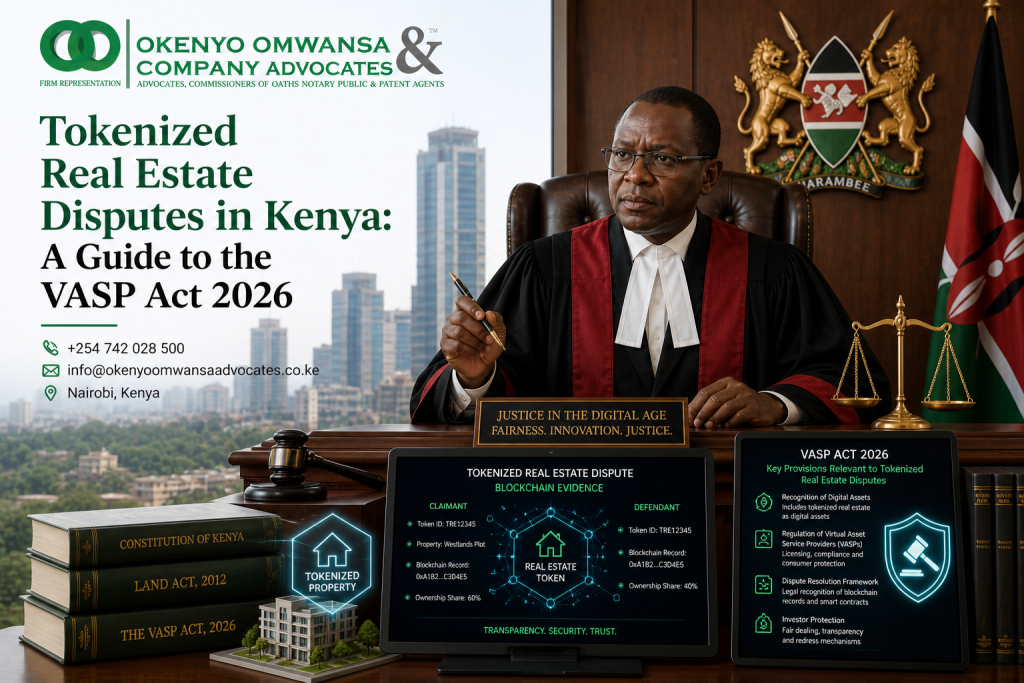
In 2026, the “shamba” is no longer just soil and a green title deed; it is a digital token on a distributed ledger. Fractional ownership—where a single apartment in Kilimani or a ranch in Nanyuki is split into 1,000 digital tokens—has democratized Kenyan real estate. But with new ways to own comes a complex new way to fight.
As of May 2026, the first wave of Tokenized Real-World Asset (RWA) disputes is hitting the Environment and Land Court (ELC). When a smart contract fails to distribute rental income, or a VASP (Virtual Asset Service Provider) platform goes insolvent, traditional land law enters a “gray zone.”
At Okenyo Omwansa & Co. Advocates, we are seeing a massive content gap: investors know how to buy tokens, but they have no idea how to sue when things go wrong. This guide breaks down the intersection of the Sectional Properties Act 2020, the VASP Act 2026, and the Law of Contract in the age of blockchain.
The Legal Conflict: Smart Contracts vs. The Land Registry
Does the Token Represent the Title?
The core of most disputes in 2026 is the “Nexus of Ownership.” Under the Land Registration Act, the registry is the ultimate source of truth. However, the VASP Act 2026 recognizes virtual assets as property.
The dispute arises when the “On-Chain” data (who owns the token) doesn’t match the “Off-Chain” registry (who is listed at Ardhi House). If a platform tokenizes a property without a proper Caution or Restriction placed on the physical title, the tokens can become “orphaned”—representing a claim to a property that the platform no longer legally controls.
Breach of Smart Contract as a Legal Cause of Action
In 2026, Kenyan courts are beginning to treat smart contracts as self-executing agreements under the Law of Contract Act (Cap 23). If a tokenized project in Machakos promised a 10% annual yield via a smart contract and the code failed, is it a technical glitch or a professional negligence claim against the VASP?
Top 3 Causes of Tokenized Property Disputes in 2026
- VASP Insolvency: The platform facilitating the fractional ownership goes under. Heirs and investors are left holding tokens but have no legal mechanism to “force” the sale of the physical asset to recoup their investment.
- Oracle Failures: The “Oracle” (the data feed that tells the blockchain the property value or rental income) provides false data, leading to incorrect payouts to token holders.
- Governance Deadlock: In fractional ownership, who decides to sell the building? If 40% of token holders want to renovate and 60% don’t, the dispute enters the realm of the Companies Act or Sectional Properties Act, depending on how the RWA was structured.
The Role of the VASP Act 2026 in Litigation
The VASP Regulations 2026 mandate that any entity offering tokenized real estate in Kenya must maintain an Indemnity Insurance Policy and a Consumer Protection Fund.
For litigants, this is a game-changer. If you are involved in a tokenized real estate dispute, your first step is no longer just the ELC Court; it is a formal complaint to the Capital Markets Authority (CMA) to trigger the VASP’s statutory bonds.
Expert Video: How the VASP Act Protects Your Property Tokens
Watch our breakdown of the 2026 regulations regarding RWA (Real World Assets) in the Kenyan market:
10 FAQs on Tokenized Real Estate Disputes (PAA Verified)
1. Can the ELC Court order the transfer of a blockchain token?
Yes. Under Section 13 of the Environment and Land Court Act, the court has the power to make any order necessary to settle a land dispute. In 2026, this includes “Mandatory Injunctions” directing a VASP licensed under the VASP Act 2026 to burn or re-issue tokens to the rightful owner as determined by the court.
2. What happens if I lose my private keys to my fractional land tokens?
Legally, “loss of keys” does not equal “loss of ownership” in Kenya. If the tokens represent an interest in land registered under the Sectional Properties Act 2020, you can petition the court for a declaration of ownership. The court can then order the VASP to invalidate the “lost” tokens and issue new ones, provided you satisfy KYC/AML requirements.
3. Is tokenized land subject to the “Spousal Consent” rule?
Absolutely. Under Section 12 of the Matrimonial Property Act, any “matrimonial property” requires spousal consent for sale or charge. If a spouse tokenizes the family home without consent, the tokens are considered an “illegal encumbrance,” and the other spouse can sue to have the tokenization voided ab initio.
4. Who is liable if a real estate smart contract is hacked in Kenya?
The VASP Act 2026 places the burden of security on the service provider. Regulation 44 states that a VASP is liable for losses resulting from “foreseeable technical failures” unless they can prove they met the CMA’s Cybersecurity Standards for Virtual Assets.
5. Can I use my land tokens as collateral for a bank loan?
While traditional banks are still cautious, the Moveable Property Security Rights Act (MPSRA) and the VASP Act 2026 allow virtual assets to be used as collateral. Disputes often arise when a lender “liquidates” the tokens without following the statutory notice periods required under the Land Act.
6. Does the “Doctrine of Notice” apply to tokenized land?
Yes. A buyer of a token is deemed to have “Constructive Notice” of any encumbrances listed on the blockchain. However, the Law Society of Kenya (LSK) warns that if the encumbrance is only on the blockchain and not at Ardhi House, a “Bona Fide Purchaser for Value” of the physical land may still take priority.
- Authority: Land Registration Act (No. 3 of 2012)
7. How are “Token Holder Meetings” legally recognized in Kenya?
Most 2026 tokenized projects use DAOs (Decentralized Autonomous Organizations). Kenyan courts look at the “Governance Whitepaper” as a Shareholders’ Agreement under the Companies Act 2015. If the DAO vote violates the rights of minority holders, the court can intervene under the “Oppression of Minority” doctrine.
8. Can the KRA attach my land tokens for unpaid taxes?
Yes. The Finance Act 2026 and the Tax Procedures Act allow the KRA to issue “Agency Notices” to VASPs. This allows the taxman to freeze or seize tokens to satisfy tax liabilities, similar to how they attach bank accounts.
9. What is the statute of limitations for a smart contract land dispute?
Under the Limitation of Actions Act (Cap 22), a contract dispute must be brought within 6 years. However, if the dispute is classified as a “Recovery of Land,” the limit is 12 years. The court’s classification depends on whether the token is seen as a “Contractual Right” or an “Interest in Land.”
10. Can I sue a foreign VASP for a Kenyan land token?
Yes, provided the land is located in Kenya. The ELC Court has “In Rem” jurisdiction over Kenyan land. Under the VASP Act 2025, any platform tokenizing Kenyan land must be licensed locally or have a local representative, making them subject to the jurisdiction of the High Court of Kenya.
Conclusion: Secure Your Digital Dirt
The future of Kenyan real estate is fractional, but the risks are total. As we move further into 2026, the intersection of PropTech and LawTech will define who stays wealthy and who loses their “shamba” to a code error.
Okenyo Omwansa & Co. Advocates is at the forefront of RWA litigation. Whether you are a developer looking to tokenize or an investor facing a platform lockout, ensure your legal strategy is as advanced as your technology.
Contact our LawTech Department for a consultation on RWA Dispute Resolution.