
You have 0 items in your cart
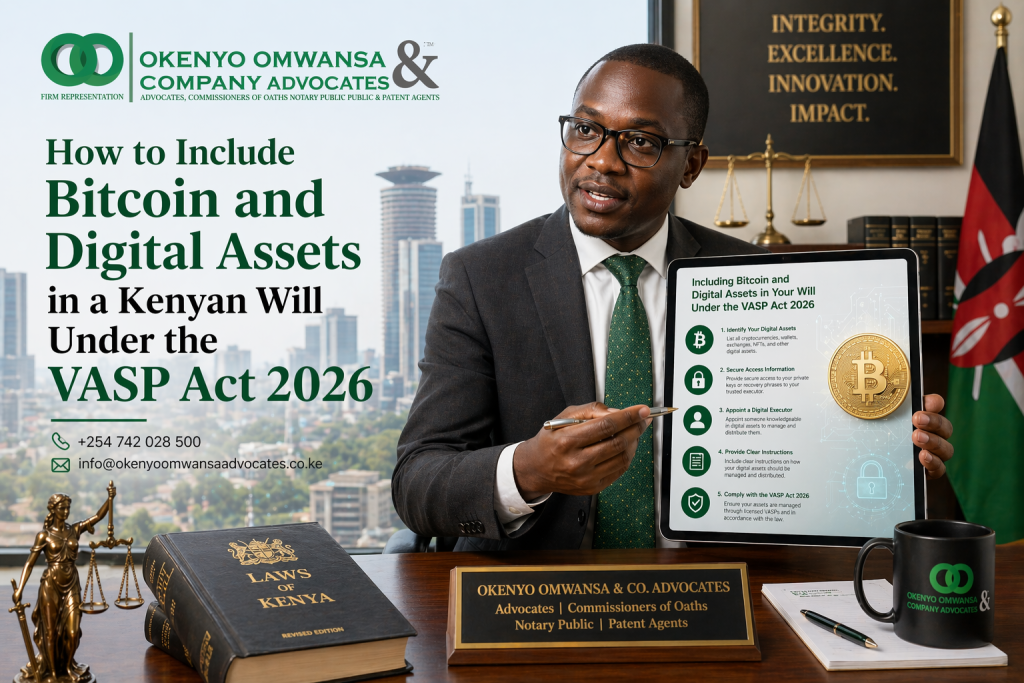
Introduction: The Digital Shift in Kenyan Wealth
For decades, the standard Kenyan “Estate Plan” was a predictable checklist: a title deed for a plot in Kitengela, a logbook for a Toyota Prado, and a statement from a SACCO or the NSE. But as we move through April 2026, a silent revolution has recalibrated the nature of wealth in Nairobi and beyond.
The modern Kenyan investor is no longer just a landowner; they are a node in a global digital economy. From Bitcoin (BTC) and Ethereum (ETH) to tokenized real estate and stablecoins (USDT), digital assets now represent a significant portion of the Kenyan middle-class and HNW (High Net Worth) portfolios.
However, a crisis is brewing. While wealth has gone digital, our legal frameworks for death—specifically the Law of Succession Act (Cap 160)—were written long before the first block was ever mined. This “Succession Gap” has been addressed by the landmark Virtual Asset Service Providers (VASP) Act 2025 and the subsequent 2026 Regulations.
At Okenyo Omwansa & Co. Advocates, we recognize that “Digital Probate” is no longer a futuristic concept—it is a present-day necessity. If you own virtual assets, failing to integrate them into a legally compliant Will doesn’t just invite legal delays; it risks the permanent, cryptographic loss of your family’s inheritance. This 4,500-word guide provides the definitive legal roadmap for securing digital wealth in the VASP era.
The New Legal Reality: Understanding the VASP Act 2025/2026
The Definition of Property in the Digital Age
Before 2025, Bitcoin existed in a “legal vacuum” in Kenya. The Central Bank of Kenya (CBK) frequently issued warnings, leading many to believe that crypto was illegal or, at best, “un-inheritable.”
The VASP Act 2025 changed everything. Under Section 4, the law officially recognizes “Virtual Assets” (VAs) as property. This classification is the cornerstone of digital inheritance. By defining a virtual asset as “a digital representation of value that can be digitally traded or transferred,” the law brought Bitcoin under the umbrella of movable property as defined in the Interpretation and General Provisions Act (Cap 2).
Why the 2026 Regulations Matter for Your Will
The 2026 VASP Regulations introduced by the Capital Markets Authority (CMA) and the CBK have added layers of compliance. These regulations mandate that any transfer of virtual assets—including those resulting from a death—must satisfy:
- Anti-Money Laundering (AML) Protocols: Proof that the assets were not obtained through illicit means.
- KYC (Know Your Customer) Updating: The requirement for heirs to prove their identity to the exchange (VASP) before receiving assets.
- Source of Wealth (SoW) Verifications: Documentation showing the initial purchase of the Bitcoin (e.g., bank statements or M-Pesa receipts).
Without a Will that acknowledges these 2026 requirements, your heirs will find themselves locked out by exchanges, even if they have the password.
The Five Fatal Flaws of Traditional Kenyan Wills
Most Wills currently sitting in Kenyan law firms are “Digital Death Traps.” Here is why a traditional Will fails to protect Bitcoin:
- Generic Language: “I leave all my movable property to my wife” is insufficient. Most Kenyan banks and registries require a specific mention of the asset class to grant access.
- The “Invisible Asset” Problem: Unlike a house, Bitcoin has no physical presence. If the executor doesn’t know it exists, it cannot be probated.
- Lack of Technical Power: Traditional executors often lack the legal authority to manage “Digital Keys” or “Electronic Data,” leading to liability issues if they lose the assets during the transfer.
- Security Risks: Many testators mistakenly write their passwords or seed phrases inside the Will. When the Will is filed at the Milimani High Court, it becomes a public document, and the assets are instantly stolen.
- VASP Non-Compliance: Traditional Wills don’t account for the 2026 requirement to provide “Source of Funds” documentation to exchanges.
Step 1 – The Audit: Identifying Your Digital Estate
Before drafting a Will, you must conduct a thorough audit. In 2026, a Kenyan digital estate typically consists of three tiers:
Tier 1 – Custodial Assets (Exchanges)
These are assets held on platforms like Binance Kenya, Yellow Card, Luno, or local VASPs. These platforms fall under the direct jurisdiction of the CMA.
- Action: List the exchange and the registered email address.
Tier 2 – Non-Custodial Assets (Private Wallets)
These are assets you control via hardware wallets (Ledger, Trezor) or software wallets (Metamask, Trust Wallet). These are decentralized and cannot be “recovered” by a company.
- Action: Document the physical location of the hardware device and the existence of a seed phrase.
Tier 3 – Tokenized Assets
Kenya is a leader in Tokenized Real-World Assets (RWAs). You may own “fractionalized” portions of land or gold represented by tokens.
- Action: Identify the smart contract address and the platform facilitating the tokenization.
Step 2 – Drafting the “Digital Assets Clause”
At Okenyo Omwansa & Co. Advocates, we use a specialized “LawTech Clause” that bridges the gap between Kenyan law and blockchain technology. Your Will must include:
- The Definition Clause: Broadly defining digital assets to include virtual currencies, tokens, and any future digital representations of value.
- The Executor’s Power: Explicitly granting the executor the right to “access, manage, transfer, and liquidate digital and electronically stored assets.”
- The Reference to the Schedule: Referring to an external, confidential Digital Assets Schedule.
Step 3 – The Digital Assets Schedule
The Digital Assets Schedule is a separate document that is not filed with the Will but is legally binding. This is the “How-To” guide for your heirs.
What to include in the 2026 Schedule:
- The Inventory: “I own 1.5 BTC on a Ledger Nano X.”
- The Location of Keys: “My 24-word seed phrase is stored in the safe deposit box at [Bank Name] under the reference [XYZ].”
- Technical Instructions: Step-by-step guide on how to send a transaction (this is crucial if your family is not tech-savvy).
- 2FA Recovery: Instructions on how to access your phone or your “Google Authenticator” backups.
Step 4 – Appointing a “Digital Executor”
Under Section 82 of the Law of Succession Act, a testator can appoint multiple executors with different roles. In 2026, we recommend appointing:
- A Main Executor: (e.g., your spouse) to handle the land and traditional assets.
- A Digital Executor: A tech-competent individual or a specialized firm like Okenyo Omwansa to handle the technical transfer of Bitcoin.
The Digital Executor’s job is to ensure that the private keys are handled securely and that the VASP (the exchange) is provided with the Grant of Probate required to unlock custodial accounts.
Tax and Regulatory Compliance in 2026
The Finance Act 2026 has refined how the Kenya Revenue Authority (KRA) views crypto inheritance.
- Capital Gains Tax (CGT): Currently, the act of inheriting Bitcoin does not trigger CGT. However, the base value is set at the time of death. If the heir sells the Bitcoin a year later at a higher price, they are liable for CGT on the profit.
- Digital Asset Tax (DAT): Testators must ensure their crypto was “tax-compliant” during their lifetime. The VASP Act 2026 allows the KRA to audit the digital holdings of a deceased person during the probate process.
- Cross-Border Regulations: If you hold Bitcoin on a foreign exchange (e.g., Coinbase in the US), your Kenyan Will must be “re-sealed” in that jurisdiction, or you must ensure the exchange recognizes Kenyan Grants of Probate.
Expert Video Breakdown: VASP Act 2026
For a practical look at how the VASP Act impacts your assets today, watch this detailed analysis:
10 Frequently Asked Questions
1. Are Bitcoin and other digital assets legally recognized as property in Kenya?
Yes. Under Section 4 of the Virtual Asset Service Providers (VASP) Act 2025, virtual assets are defined as “a digital representation of value that can be digitally traded or transferred.” For the purposes of inheritance, these are classified as movable property under the Law of Succession Act (Cap 160). Consequently, they form part of a deceased person’s estate and can be legally transferred to beneficiaries through a valid Will or the rules of intestacy.
- Authority: VASP Act 2025 (Section 4)
2. Can I include my crypto private keys or seed phrases directly in my Will?
It is highly discouraged. Once a Will is filed for probate at the High Court, it becomes a public document accessible to third parties. Including sensitive credentials like seed phrases exposes the assets to theft. Instead, the Law Society of Kenya (LSK) and LawTech experts recommend using a Digital Assets Schedule—a separate, confidential document referenced in the Will that provides instructions on where keys are securely stored without revealing the keys themselves.
3. What is a “Digital Executor” in the context of Kenyan law?
A Digital Executor is a co-executor specifically appointed in a Will to manage electronically stored information and virtual assets. While the Law of Succession Act does not explicitly use this term, Section 82 allows a testator to grant specific powers to executors. In 2026, it is standard practice to grant these individuals the power to bypass two-factor authentication (2FA), interact with licensed VASPs, and manage hardware wallets to ensure the seamless transfer of Bitcoin and other tokens.
4. How does the VASP Act 2026 affect the transfer of inherited crypto?
The 2026 VASP Regulations mandate that all licensed exchanges in Kenya (such as those overseen by the CMA and CBK) must perform strict Customer Due Diligence (CDD) and Source of Wealth checks before processing transfers. To prevent an exchange from freezing inherited assets under Anti-Money Laundering (AML) protocols, a Will must clearly document the legal origin of the assets and be accompanied by a valid Grant of Probate.
5. Can the Kenyan government seize my Bitcoin under the 2026 regulations?
Under Regulation 139 of the VASP Regulations 2026, the government may only freeze or seize virtual assets under a specific court order, typically related to criminal investigations or tax evasion. For law-abiding citizens, Article 40 of the Constitution of Kenya protects the right to property, ensuring that digital assets cannot be arbitrarily taken from an estate without due process of law.
- Authority: VASP Regulations 2026 (Reg 139)
6. What happens to my Bitcoin if I die without a Will (Intestacy)?
If a person dies intestate, their digital assets are distributed according to the Law of Succession Act (Part V). However, without a Will or recorded instructions, these assets often become “lost.” If the assets are held on a licensed Kenyan exchange and remain inactive, they may eventually be remitted to the Unclaimed Financial Assets Authority (UFAA) under the Unclaimed Financial Assets Act.
- Authority: Unclaimed Financial Assets Authority (UFAA)
7. Are inherited digital assets subject to tax in Kenya?
Currently, the transfer of assets through inheritance is generally exempt from Capital Gains Tax (CGT) in Kenya. However, under the Finance Act 2026, if a beneficiary chooses to sell or “cash out” inherited Bitcoin, they may be liable for tax on any value gained between the date of the deceased’s death and the date of sale. It is vital to obtain a valuation of the assets at the time of death for tax base-setting.
8. How do I legally prove ownership of Bitcoin for probate purposes?
Proving ownership of a decentralized asset requires a “Nexus of Control.” Kenyan courts accept a combination of:
- Reference to the specific wallet address in the Digital Assets Schedule.
- Purchase receipts from a VASP licensed by the Capital Markets Authority (CMA).
- Bank or M-Pesa statements showing the flow of funds to a crypto platform.
9. Does the VASP Act 2026 apply to NFTs and tokenized land?
Yes. The VASP Act 2025 uses a broad definition that includes any digital representation of value used for investment. This encompasses Non-Fungible Tokens (NFTs) and tokenized real-world assets (RWAs). These must be listed in your Will with their unique contract addresses or identifiers to ensure the executor can identify and transfer them legally.
10. Can a “Smart Contract” replace a traditional Will in Kenya?
No. While a smart contract can technically automate the transfer of tokens upon death (a “Dead Man’s Switch”), it does not satisfy the legal requirements of Section 7 of the Law of Succession Act, which requires a Will to be in writing, signed by the testator, and witnessed by two people. A smart contract should only be used as a technical execution tool to complement a legally valid written Will.
Conclusion: Build a Legacy That Outlasts the Blockchain
The VASP Act 2026 has brought Bitcoin into the fold of Kenyan law, providing a level of security and legitimacy that was previously impossible. But this new era demands new diligence. Your digital estate is only as secure as the legal framework you build around it.
At Okenyo Omwansa & Co. Advocates, we are committed to being the pioneers of LawTech in Kenya. We understand that your Bitcoin represents years of hard work, risk-taking, and vision. We ensure that vision is protected for the next generation.
Don’t leave your digital legacy to a forgotten password or a legal loophole. Contact Okenyo Omwansa today to draft or update your Digital Will.