
You have 0 items in your cart
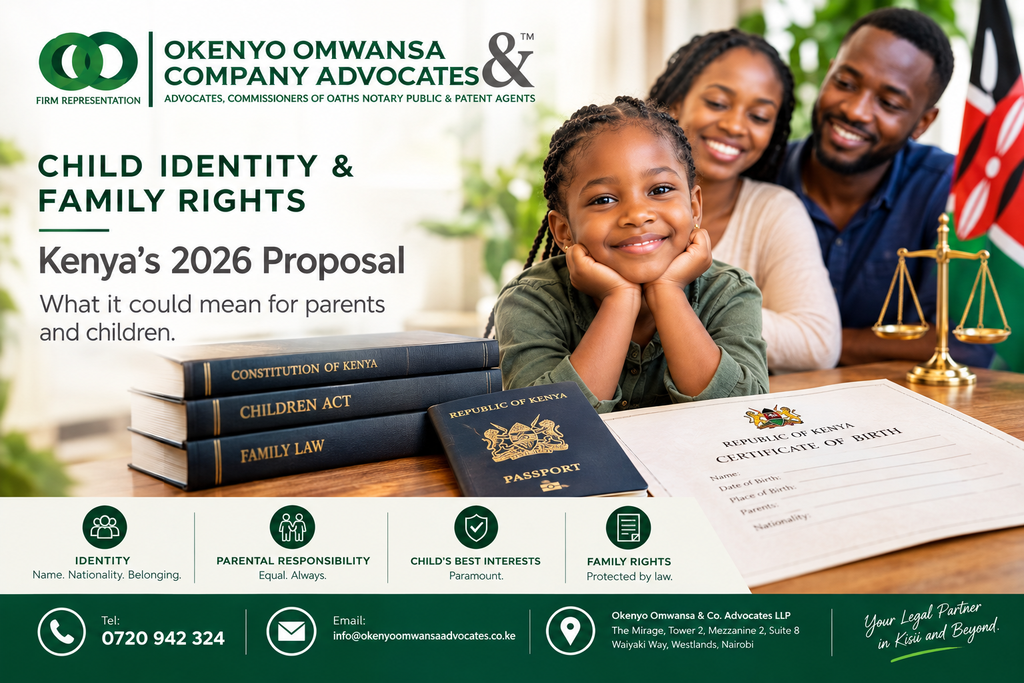
A child’s identity is more than a name on a birth certificate.
The Child Identity and Family Integrity Bill, 2026 is a proposed piece of legislation in Kenya sponsored by MP Dr. James Nyikal and Renson Yeri that seeks to introduce mandatory DNA verification of parentage at birth.
It can include the child’s name, nationality, family relationships, parental links and the records that establish who the child is and where the child belongs.
In Kenya, these issues are already protected by the Constitution and the Children Act. The Constitution gives every child the right to a name and nationality from birth and to parental care and protection, including equal responsibility of the mother and father whether or not they are married. It also makes the child’s best interests paramount in every matter concerning the child. Kenya Law
Against that background, a Children (Amendment) Bill, 2026 has appeared in Parliament’s legislative-proposals tracker. The proposal is sponsored by Nominated MP Hon. Umulkher Harun Mohamed. The parliamentary tracker confirms its existence as a legislative proposal, but the material currently publicly available does not provide enough detail to responsibly describe every proposed clause or claim that it has become law. Parliament of Kenya
That distinction matters.
A legislative proposal is not the same thing as an enacted Act of Parliament.
So what should Kenyan parents understand about child identity, parentage and family rights while these issues continue to develop?
What Is a Child’s Legal Identity?
A child’s legal identity is created and documented through several legal records and relationships.
These may include:
- The child’s name
- Date and place of birth
- Nationality
- Birth registration
- Parentage
- Family relationships
- Adoption records where applicable
- Other official records identifying the child
The Constitution expressly provides that every child has a right to a name and nationality from birth. Kenya Law
The Children Act also places responsibilities on parents relating to the child’s name and birth registration. Among the duties of a person with parental responsibility is determining the child’s name and procuring registration of the child’s birth. Kenya Law
This means that birth registration is not simply an administrative formality.
It is part of establishing the child’s legal identity.
Why Does Child Identity Matter?
A child’s identity can affect many areas of life.
For example, identity documents may be relevant when a child needs to:
- Access education
- Obtain government services
- Establish nationality
- Travel
- Obtain a passport
- Access healthcare
- Participate in an adoption process
- Establish parental relationships
- Resolve a succession or inheritance issue later in life
The importance of accurate identity becomes particularly obvious when information is missing or disputed.
Consider a child whose birth certificate does not accurately reflect their circumstances.
Or a child whose parentage is disputed.
Or a child who has been abandoned and whose biological parents cannot be traced.
These are not merely paperwork problems.
They can become legal and family-law problems.
What Does Kenyan Law Already Say About Parents?
Kenya’s current legal framework already recognises equal parental responsibility.
Section 32 of the Children Act provides that parents have parental responsibility on an equal basis and that neither the father nor mother has a superior right or claim over the other in exercising parental responsibility, whether the child was born within or outside marriage. Kenya Law
This is consistent with Article 53 of the Constitution, which provides for equal responsibility of the mother and father to provide for the child. Kenya Law
Therefore, a family dispute cannot simply be approached from the assumption that one parent automatically has superior legal rights because of their gender or marital status.
The circumstances of the child and the applicable law matter.
What Happens When Parents Disagree About a Child’s Identity?
Disputes can arise over matters such as:
- The child’s name
- Surname
- Father’s name on the birth certificate
- Whether a person is a child’s parent
- DNA testing
- Changing information on a birth certificate
- Nationality
- Adoption
- Custody
- Parental responsibility
These matters can become especially complicated where the parents disagree.
A recent 2026 High Court decision illustrates the point.
In In re WBN (Minor), the High Court considered an application concerning the removal of a father’s name from a child’s birth certificate and a change to the child’s name. The case demonstrates that questions surrounding birth records and parentage can become matters for judicial determination. SheriaNet
The lesson for parents is straightforward:
Do not assume that information on a child’s birth record can simply be changed informally whenever the parents disagree.
The appropriate procedure depends on the circumstances.
Can a Father’s Name Be Added to a Birth Certificate?
Kenya’s Births and Deaths Registration Act contains specific rules concerning entry of the father in the birth register.
Section 12 provides that a person may not be entered as the father of a child except at the joint request of the father and mother or upon production of evidence required by the registrar concerning marriage under the applicable legal provisions. Kenya Law
This means that establishing or changing parentage on official records is a legal process.
Where the parents disagree, or where parentage is contested, legal advice may be necessary before attempting to alter the records.
What If the Father Is Not Named?
The absence of a father’s name from a birth certificate does not necessarily resolve every question concerning biological or legal parentage.
There may be circumstances in which:
- The father was unknown
- The parents were not together
- The parents disagreed about registration
- The father was unavailable
- Parentage was disputed
- The child’s circumstances later changed
Where a dispute arises, the relevant evidence and legal procedure need to be considered.
The child’s best interests remain central to proceedings concerning children. The Children Act expressly provides that the best interests of the child are the primary consideration in actions concerning children. Kenya Law
What If a Child Does Not Know Their Biological Parents?
This can arise in cases involving abandonment, adoption or situations where a child’s biological family cannot be identified.
Kenyan courts have dealt with cases involving children who were abandoned shortly after birth.
For example, in In re Baby A (Child), the High Court dealt with a child whose parents and nationality were initially unknown. The court applied Article 14(4) of the Constitution, which provides that a child found in Kenya who is or appears to be under eight years old and whose nationality and parents are unknown is presumed to be a Kenyan citizen by birth. Kenya Law
A later 2025 adoption decision similarly considered an abandoned child’s nationality, adoption and legal identity. Kenya Law
These cases demonstrate why child identity can become particularly important in adoption and child-protection proceedings.
What Role Does the Child’s Best Interest Play?
This is one of the most important principles in Kenyan children’s law.
Article 53(2) of the Constitution states that:
“A child’s best interests are of paramount importance in every matter concerning the child.” Kenya Law
The Children Act implements this constitutional principle.
This means that a dispute between adults should not automatically be treated as a contest in which one parent’s preferred outcome wins.
The court’s focus is the welfare and best interests of the child.
Depending on the circumstances, that can involve considerations such as:
- Safety
- Care
- Family relationships
- Education
- Health
- Stability
- The child’s views, depending on age and maturity
- Existing parental relationships
What About Family Relationships?
A child’s identity is closely connected to family relationships.
A child may have relationships with:
- Mother
- Father
- Siblings
- Grandparents
- Step-parents
- Other relatives
- Adoptive parents
The law does not treat every family dispute simply as a dispute between two adults.
The Children Act provides a framework dealing with parental responsibility, custody, care and protection, guardianship, foster care and adoption. Kenya Law
This becomes especially important where parents separate.
A separation does not automatically end a parent’s responsibilities toward the child.
Does Marriage Determine Parental Responsibility?
Not in the way many people assume.
The Children Act expressly states that equal parental responsibility applies whether or not the child was born within or outside wedlock. Kenya Law
The Constitution similarly provides for equal responsibility of the mother and father to provide for the child, whether they are married to each other or not. Kenya Law
Therefore, parents should avoid assuming that marriage—or the absence of marriage—automatically determines all questions concerning parental responsibility.
What Could the 2026 Proposal Mean?
At present, caution is necessary.
Parliament’s legislative-proposals tracker confirms that a Children (Amendment) Bill, 2026 was submitted as a proposal by Hon. Umulkher Harun Mohamed. Parliament of Kenya
However, the publicly available tracker does not itself provide sufficient clause-by-clause detail to state that the proposal will definitely change a particular rule on child identity or family relationships.
Accordingly, parents should distinguish between three different things:
1. Existing law
These are rules already contained in the Constitution, Children Act and other applicable legislation.
2. A legislative proposal
This is an attempt to change or develop the law.
3. An enacted law
This is legislation that has completed the constitutional parliamentary process and has come into force.
A proposal should not be presented to the public as though it were already law.
Why Parents Should Pay Attention to Proposed Changes
Family law affects issues that are deeply personal.
A legislative change concerning children could potentially affect questions such as:
- Parentage
- Birth registration
- Parental responsibility
- Custody
- Child protection
- Adoption
- Family relationships
- Children’s participation in decisions affecting them
For that reason, parents should look beyond social-media headlines and ask:
What exactly does the proposed legislation say?
Which existing section does it amend?
Has it been introduced in Parliament?
Has it passed?
Has it received presidential assent?
Has it commenced?
Those questions can make the difference between understanding a proposed legal reform and mistakenly treating a proposal as current law.
Child Identity Disputes Can Become Family-Court Matters
A disagreement over a birth certificate may appear administrative at first.
But it can become much more complicated if it involves:
- A disputed biological father
- A custody dispute
- Maintenance
- Adoption
- Immigration
- Nationality
- Inheritance
- Allegations of fraud
- DNA evidence
The 2026 High Court decision in In re WBN (Minor) is an example of how a dispute involving a child’s birth record and name can reach the High Court. SheriaNet
This is why parents should obtain legal advice before making significant changes to a child’s official identity records.
What Should Parents Do If There Is a Dispute?
If you are facing a dispute concerning a child’s identity or family relationship, consider obtaining legal advice before taking unilateral action.
Depending on the circumstances, relevant documents may include:
- Birth certificate
- Parents’ identification documents
- Marriage certificate, where applicable
- Adoption documents
- Court orders
- DNA evidence or reports, where legally relevant
- School records
- Medical records
- Immigration documents
- Previous correspondence concerning parentage
The exact documents required depend on the dispute.
Common Mistakes Parents Should Avoid
1. Treating the birth certificate as the end of the issue
A birth certificate is important evidence, but some disputes may require additional legal determination.
2. Changing a child’s name without understanding the legal consequences
A child’s name can be an important element of their identity.
3. Assuming a parent automatically loses responsibility after separation
Equal parental responsibility remains a key principle under the Children Act. Kenya Law
4. Making unilateral decisions about major issues
Where parents share parental responsibility, major decisions may require consideration of the other parent’s rights and any existing court orders.
5. Relying on social-media interpretations of proposed legislation
A Bill is not necessarily law.
Always establish its actual parliamentary status and read the relevant provisions.
What This Means for Families in Kisii
For families in Kisii, these issues can arise in ordinary family disputes involving:
- Separation
- Child maintenance
- Custody
- Birth registration
- Paternity disputes
- Adoption
- Guardianship
- Children’s names
- Parental responsibility
The location of the family does not remove the application of Kenya’s national constitutional and statutory framework.
If a dispute has reached the point where parents cannot agree, obtaining legal advice early can help clarify the available options before the disagreement becomes a larger court dispute.
How Okenyo Omwansa & Co. Advocates LLP Can Help
Family-law disputes involving children require more than simply determining which parent is right.
The central question is often:
What outcome protects the child’s legal rights and best interests while respecting the rights and responsibilities of the parents?
Okenyo Omwansa & Co. Advocates LLP assists clients with family-law matters including:
- Child custody disputes
- Child maintenance
- Parental responsibility
- Guardianship
- Adoption matters
- Family disputes
- Children’s rights
- Succession and family-related property matters
- Legal advice concerning family relationships
The firm can also advise clients on the legal implications of proposed changes where legislation affecting families is under consideration.
Frequently Asked Questions
Is the Child Identity and Family Bill 2026 already law in Kenya?
The official parliamentary material I could verify identifies a Children (Amendment) Bill, 2026 as a legislative proposal sponsored by Hon. Umulkher Harun Mohamed. The available tracker does not establish that it has become law. Parliament of Kenya
Does every child have a right to a name and nationality?
Yes. Article 53 of the Constitution provides that every child has the right to a name and nationality from birth. Kenya Law
Do unmarried parents have equal parental responsibility?
The Children Act provides that parents have parental responsibility on an equal basis, whether or not the child was born within or outside wedlock. Kenya Law
Can a child’s father’s name be changed on a birth certificate?
It may be possible in appropriate circumstances, but the applicable procedure depends on the facts. Disputes concerning parentage or birth records may require formal legal proceedings. A 2026 High Court case demonstrates that such issues can reach court. SheriaNet
What happens when a child’s parents are unknown?
The Constitution provides that a child found in Kenya who is or appears to be under eight years old and whose nationality and parents are unknown is presumed to be a Kenyan citizen by birth. Kenya Law
What is the most important principle in a children’s case?
The best interests of the child are paramount under Article 53(2) of the Constitution. Kenya Law
Final Word
A child’s identity is not merely information contained in a government database.
It connects the child to their name, nationality, parents, family and legal rights.
Kenya’s Constitution and Children Act already provide substantial protection for these interests. At the same time, Parliament’s 2026 legislative agenda includes a proposed Children (Amendment) Bill, 2026, which means parents and family-law practitioners should pay attention to how the proposal develops. Parliament of Kenya
For now, the safest approach is to distinguish carefully between what Kenyan law currently provides and what Parliament is proposing to change.
When a child’s identity or family relationship is disputed, the consequences can extend well beyond the immediate disagreement.
Get the legal position clear before making a decision that may affect a child’s identity for life.
Okenyo Omwansa & Co. Advocates LLP
The Mirage, Tower 2, Mezzanine 2, Suite 8
Waiyaki Way, Westlands, Nairobi
Tel: 0720 942 324
Email: info@okenyoomwansaadvocates.co.ke
This article is for general information only and does not constitute legal advice. The status and wording of proposed legislation may change during the legislative process. Specific family and children’s matters should be assessed on their individual facts and the law applicable at the time.