You have 0 items in your cart

Imagine conducting a routine land search only to discover that the property you have owned for years is now registered in someone else’s name. Alternatively, you may receive a phone call informing you that someone has fenced your land, started construction, or claimed to have purchased your property.
For many landowners in Kenya, discovering that their land has been sold, transferred or registered without their knowledge is both shocking and frightening.
The immediate questions are usually:
- Can someone legally sell my land without my consent?
- What if my signature was forged?
- What happens if the land has already been transferred to another person?
- Can I stop the new owner from selling it again?
- Can the title deed be cancelled?
- Do I report the matter to the police or go to court?
- How can I recover my land?
The good news is that Kenyan law provides legal mechanisms for challenging fraudulent, illegal or unauthorised land transactions. However, the appropriate remedy depends on how the transfer happened, who is currently registered as the owner, whether another person has acquired an interest in the land, and what evidence is available.
If someone has sold or transferred your land without your knowledge, acting quickly can be important in preventing further dealings and protecting your legal position.
Can Someone Sell Your Land Without Your Knowledge in Kenya?
Generally, a person cannot lawfully sell and transfer your land without having the legal authority to do so.
A valid land transaction ordinarily requires the registered proprietor’s involvement or a legally recognised authority to act on the proprietor’s behalf. Depending on the circumstances, this may involve a properly executed transfer, valid Power of Attorney, company authority, succession documents, court orders, or other legally recognised instruments.
However, fraudulent transactions sometimes occur through:
- Forged signatures on transfer documents.
- Impersonation of the registered owner.
- Fraudulent Powers of Attorney.
- Forged identity documents.
- Fraudulent applications for replacement title deeds.
- Unauthorised transactions involving family or jointly owned land.
- Fraudulent succession proceedings.
- Misuse of company documents or resolutions.
- Collusion involving intermediaries or persons handling registration.
- Illegal registration of a transfer at the land registry.
In some cases, the registered owner may only discover the transaction when conducting an official search, attempting to sell the land, visiting the property, or receiving information from a third party.
The fact that another person appears on the land register does not necessarily mean the transfer was legally valid.
How Do You Discover That Your Land Has Been Sold Without Your Consent?
Landowners often discover unauthorised transactions in different ways.
1. An official land search reveals a new owner
You may conduct a search using your parcel number and discover that the registered proprietor has changed.
This is one of the most serious warning signs. The search may also reveal a new charge, lease, restriction, caution, subdivision or other registered dealing.
2. Someone claims to have purchased your land
A person may approach you claiming ownership, produce a title deed, show a sale agreement, or demand that you vacate the property.
Do not assume the claim is genuine or false without investigating the documents and registration history.
3. You discover construction or fencing on your land
You may find that someone has fenced the property, subdivided it, erected structures, planted crops or begun construction without your permission.
This may involve trespass, an ownership dispute or an attempted transfer. The physical activity should be investigated alongside the land register.
4. You receive information that your title deed has been replaced
A fraudulent person may have allegedly reported a title deed as lost and obtained a replacement document.
If you still possess your original title deed but a different title has been issued or registered, the circumstances require urgent investigation.
5. You discover a suspicious transaction involving a relative or family member
Family land disputes can involve unauthorised sales, alleged gifts, fraudulent succession documents or transfers made by someone who claims to have authority over the property.
The legal position may depend on the registered ownership, succession status, the nature of any trust or beneficial interest, and the documents used to effect the transaction.
What Should You Do Immediately If Your Land Has Been Sold Without Your Knowledge?
If you suspect that your land has been transferred without your consent, avoid confrontation and begin documenting the matter.
Step 1: Conduct an official land search
Obtain an official search for the parcel using the correct land reference number.
The search may help establish:
- The current registered proprietor.
- Whether ownership has changed.
- Registered charges or encumbrances.
- Cautions or restrictions.
- Other entries affecting the land.
- The apparent status of the title.
Where the search reveals an unexpected transfer, obtain and preserve a copy.
You can begin through the official Ardhisasa land services platform, where applicable, or through the relevant land registry.
An official search is an important starting point, but it may not reveal every underlying irregularity. A more detailed investigation may be necessary to examine the instruments used to register the transfer and the history of the property.
Step 2: Preserve your original title deed and documents
Do not surrender your original title deed, identity documents, signed transfer forms, sale agreements or other original records to an unfamiliar person.
Collect and preserve:
- Your original title deed or certificate of lease.
- Copies of previous official searches.
- Sale agreements relating to the property.
- Transfer documents, if any.
- Identity documents used in earlier transactions.
- Land rates and rent payment records.
- Survey documents and beacon certificates.
- Correspondence with the Land Registry.
- Photographs of the property.
- Evidence of occupation, possession or development.
- Any documents showing that you never authorised the disputed transaction.
If you believe a signature has been forged, preserve the document and avoid marking, altering or damaging it.
Step 3: Investigate the transfer that changed ownership
The next step is to establish exactly how the land was transferred.
A lawyer may need to investigate the relevant registration records and transaction documents, including:
- The transfer instrument.
- The application or documents used to support registration.
- The identity documents submitted.
- The signature or thumbprint appearing on the documents.
- Any Power of Attorney relied upon.
- Consent documents, where required.
- Stamp duty documentation.
- Relevant succession documents.
- Company resolutions or other authority, where applicable.
- The date and sequence of registration entries.
This investigation is important because different forms of fraud require different evidence and legal responses.
For example, an alleged forged signature may require examination of the disputed document. An unauthorised Power of Attorney may require investigation into its execution, registration and scope. A transfer arising from succession proceedings may require examination of the probate or administration process.
Step 4: Report suspected land fraud to the Directorate of Criminal Investigations
Where the circumstances suggest forgery, impersonation, fraudulent registration or other criminal conduct, you may report the matter to the Directorate of Criminal Investigations (DCI).
The DCI identifies land-related offences among the matters it investigates, including forgery of title documents, fraudulent procurement of registration, making documents without authority and uttering false documents.
The DCI explains its formal reporting process for land-related matters through its official FAQs.
Your complaint should clearly explain:
- Your ownership or interest in the property.
- The parcel number and location.
- How you discovered the alleged transfer.
- The transaction or registration you dispute.
- The people involved, where known.
- The documents or signatures you believe are fraudulent.
- The evidence you have preserved.
- Any immediate threat of further transfer, occupation or development.
Keep a copy of your complaint and any reference or acknowledgment received.
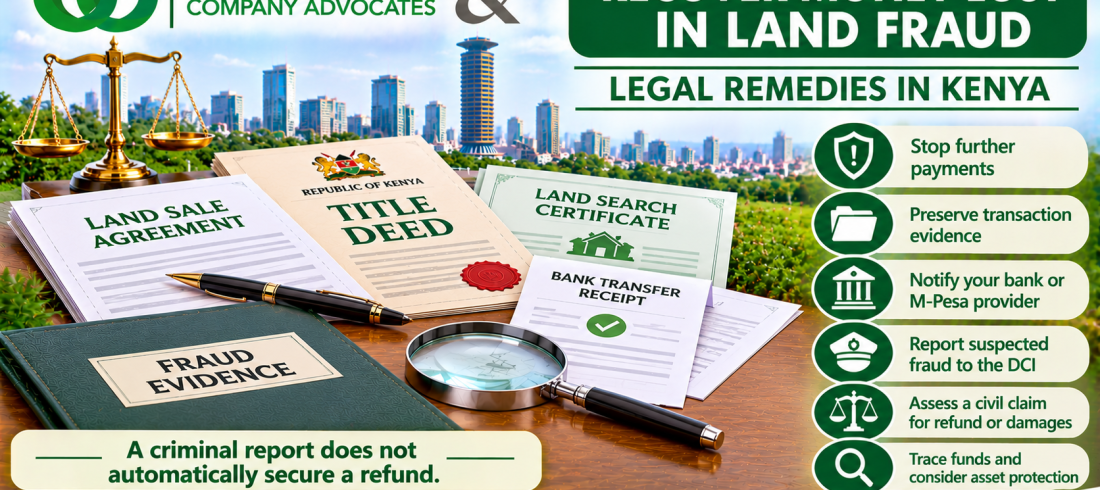
Criminal investigations may help establish how the fraudulent transaction occurred and identify those responsible. However, reporting a matter to the DCI does not automatically cancel a registered title or restore ownership. Civil legal action may also be necessary.
Can You Stop the New Owner From Selling Your Land Again?
Yes, there may be legal options for preventing further dealings with disputed land, but the appropriate procedure depends on your legal interest and the circumstances.
The risk is that the person currently registered may attempt to transfer the property again, charge it to a bank, subdivide it, lease it or otherwise create additional interests.
Lodging a caution
Under the Land Registration Act, a person claiming a qualifying interest in land may, in appropriate circumstances, lodge a caution to protect that interest.
A caution can alert the registry to the claim and affect the registration of certain dealings, subject to the law and the circumstances.
You should not assume that anyone can lodge a caution simply because they have a disagreement with the registered owner. The person lodging it must have a legally qualifying interest, and the process has statutory requirements.
Seeking an inhibition
An inhibition may be another available protective measure.
An inhibition can restrict dealings with the land in accordance with the applicable law and order. In a serious dispute involving an alleged fraudulent transfer, a lawyer may consider whether an inhibition or other appropriate order is necessary to preserve the property while the dispute is being resolved.
Applying for a court injunction
Where the facts justify urgent court intervention, you may seek a temporary injunction restraining further dealings with the land.
Depending on the circumstances, the application may seek to prevent:
- A further sale or transfer.
- Subdivision.
- Charging the property.
- Construction or development.
- Interference with possession.
- Eviction or other acts affecting the disputed property.
An injunction is not automatic. The court will assess the evidence and the applicable legal requirements.
For a deeper explanation of protective measures, see our guide on Cautions and Caveats in Land Transactions in Kenya.
Can a Fraudulently Transferred Title Deed Be Cancelled in Kenya?
Yes. A title may be challenged where the evidence establishes a legally recognised ground for doing so.
Section 26 of the Land Registration Act provides that a certificate of title is prima facie evidence of proprietorship, subject to the statutory exceptions, including fraud or misrepresentation to which the proprietor is proved to be a party, or acquisition of the title illegally, unprocedurally or through a corrupt scheme.
This means that registration does not necessarily protect a title obtained through an unlawful process.
However, alleging fraud is not enough. A person challenging a title must present evidence supporting the allegations and properly identify the legal basis for the challenge.
What does Section 80 of the Land Registration Act provide?
Section 80 of the Land Registration Act empowers the court, subject to the statutory conditions, to order rectification of the register where a registration was obtained, made or omitted by fraud or mistake.
Depending on the evidence, rectification may involve cancellation or amendment of a registration.
However, the law also contains protections relating to certain proprietors who are in possession and acquired their interest for valuable consideration without the relevant knowledge of, involvement in, or contribution to the fraud or mistake.
Therefore, the outcome of a fraudulent land transfer case may depend on:
- How the original fraud occurred.
- Whether the current registered proprietor participated in it.
- Whether the current proprietor knew of the fraud.
- Whether the land was acquired for valuable consideration.
- Whether the purchaser was in possession.
- Whether the purchaser contributed to the fraud or mistake.
- The transaction history.
- The quality of the evidence presented.
You can review the Land Registration Act for the relevant provisions.
What If the Person Who Fraudulently Sold Your Land Has Already Sold It to Someone Else?
This is one of the most complicated situations in land fraud disputes.
You may discover that your land was first transferred to one person and subsequently sold or transferred to another person.
The second purchaser may argue that they bought the land in good faith, paid the purchase price and had no knowledge of the original fraud.
The law does not treat every subsequent transfer in the same way. The circumstances of the acquisition, the purchaser’s conduct, the transaction documents, the history of the title and the statutory protections applicable to the purchaser may all be relevant.
A court may examine whether the purchaser:
- Conducted reasonable due diligence.
- Verified the seller’s ownership and authority.
- Paid valuable consideration.
- Had knowledge of the alleged fraud.
- Was involved in or contributed to the unlawful transaction.
- Ignored warning signs or irregularities.
- Took possession in circumstances consistent with a legitimate purchase.
This is why it is important to investigate the entire chain of transactions rather than focusing only on the latest title deed.
If the land has been transferred several times, the legal strategy may need to address each relevant transaction and each party’s role.
What Legal Remedies Can You Seek?
Depending on the facts and evidence, a landowner whose property has been fraudulently transferred may consider several remedies.
1. Cancellation of the fraudulent registration
You may seek an order cancelling a registration that was obtained through fraud or another legally recognised ground.
2. Rectification of the land register
You may seek an order directing the register to be corrected to reflect the legally established ownership position.
3. A declaration of ownership
You may ask the court to declare your legal rights and ownership of the disputed property.
4. A permanent injunction
A permanent injunction may be sought to restrain unlawful interference with your property after the dispute has been determined.
5. Recovery of possession
If you have been dispossessed, you may seek appropriate orders for recovery of possession, subject to the facts and applicable law.
6. Temporary injunction
Where urgent protection is necessary, you may seek interim relief while the substantive dispute is pending.
7. Damages
Where legally justified, you may pursue damages against parties responsible for the unlawful transaction or resulting loss.
The availability of each remedy depends on the facts, the evidence, the parties involved and the applicable law. It is important to formulate the claim carefully instead of assuming that every fraudulent transaction produces the same remedy.
What Evidence Is Needed to Prove That Your Land Was Sold Fraudulently?
Land fraud allegations require more than suspicion.
You should begin gathering evidence that establishes your original ownership, the disputed transaction and the circumstances surrounding the alleged fraud.
Useful evidence may include:
- Original title deed or certificate of lease.
- Official searches showing the ownership history.
- Certified copies of disputed transfer documents, where available.
- Documents showing your identity and signature.
- Evidence of alleged impersonation.
- Correspondence with the Land Registry.
- DCI complaint documents and investigation records, where available.
- Photographs of the property.
- Evidence of occupation or possession.
- Land rates or rent records.
- Sale agreements and transaction records.
- Witness statements.
- Survey or parcel identification records.
- Succession documents, where relevant.
- Evidence of payments or transactions involving the alleged fraudster.
If the case involves a disputed signature, forensic examination may become relevant.
If it involves a forged Power of Attorney, the authority and execution of that document may need to be investigated.
If it involves family land or succession, the succession proceedings and the authority of the person who transferred the property may be central to the dispute.
What If Your Land Was Sold Through a Forged Power of Attorney?
A Power of Attorney is a legal instrument through which one person authorises another to act on their behalf within the scope of the authority granted.
It can be useful for property owners who are abroad, elderly, unavailable or unable to handle transactions personally.
However, fraudulent persons may misuse or forge Powers of Attorney to transfer property without the registered owner’s knowledge.
If a transfer was allegedly undertaken through a Power of Attorney you never granted, the investigation may need to establish:
- Whether the document is genuine.
- Whether it was properly executed.
- Whether it was registered where required.
- Whether it gave the agent authority to sell or transfer the land.
- Whether the agent acted within the scope of that authority.
- Whether the transfer was registered using the document.
- Whether the purported agent or other participants committed fraud.
Property owners living abroad should be particularly careful when appointing representatives.
Our related guide explains the legal safeguards involved in Buying Property in Kenya from Abroad: How to Verify the Title, Seller and Developer Before Sending Money.
What If Someone Has Sold Family Land Without Your Knowledge?
Family land disputes may involve more than one legal issue.
The person who allegedly sold the land may claim that they were the registered owner, an administrator of an estate, a trustee, a beneficiary or a person authorised by the family.
The legal position depends on the ownership structure and the documents involved.
For example, the dispute may involve:
- Land registered in the name of a deceased parent.
- An estate that has not been properly administered.
- A transfer made using allegedly fraudulent succession documents.
- Land registered in the name of one family member but held under a trust.
- A sale by an administrator who exceeded their authority.
- A dispute involving beneficiaries.
- A transaction involving jointly owned property.
If the land belonged to a deceased person, the succession process and the authority of the person who purportedly sold it must be examined.
Read our guide on Land Succession in Kisii: How to Inherit, Transfer or Sell Family Land Legally for more information on succession-related land issues.
What If You Are Living Abroad and Discover That Your Kenyan Land Has Been Sold?
Discovering that your land in Kenya has been transferred while you are living abroad can make the situation even more difficult.
You may not be able to visit the land registry, inspect the property, obtain documents or attend meetings in person.
However, you should not delay action simply because you are outside Kenya.
You can begin by:
- Obtaining an official land search.
- Preserving your title deed and transaction documents.
- Identifying the disputed registration.
- Instructing a Kenyan advocate to investigate the transaction.
- Arranging appropriate representation where necessary.
- Considering protective legal measures.
- Reporting suspected criminal conduct.
- Pursuing civil remedies where appropriate.
A properly authorised legal representative may help with the investigation and legal process, subject to the applicable requirements.
Our article on Owning an Apartment in Kenya While Living Abroad: How Diaspora Property Owners Can Protect Their Investment discusses the practical challenges of protecting Kenyan property from abroad.
Should You Go to the Police or Hire a Lawyer First?
In suspected land fraud cases, both criminal reporting and civil legal action may be relevant.
The DCI investigates suspected criminal conduct, including forgery and fraudulent procurement of registration.
An advocate can help you:
- Investigate the registration history.
- Review the disputed documents.
- Identify the appropriate parties.
- Assess the legal grounds for challenging the title.
- Advise on cautions, inhibitions or other protective steps.
- Prepare urgent court applications where appropriate.
- File a claim seeking appropriate orders.
- Coordinate the civil process with any criminal investigation.
A criminal investigation and a civil land case serve different purposes.
A criminal investigation seeks to investigate alleged offences and identify persons responsible. A civil case may be necessary to determine ownership, seek rectification of the register, obtain injunctions or recover possession.
In some circumstances, waiting for a criminal investigation to conclude before taking civil action could expose the property to further dealings. The timing and approach should therefore be assessed promptly.
How Long Does It Take to Recover Land That Was Fraudulently Sold?
There is no single timeline for recovering land in Kenya following an alleged fraudulent sale.
The duration may depend on:
- The complexity of the fraud.
- The number of parties involved.
- Whether the title has been transferred multiple times.
- Whether the land has been subdivided.
- Whether the current proprietor disputes the allegations.
- The availability of documentary evidence.
- Whether urgent interim orders are necessary.
- Whether the matter proceeds to a full hearing.
- Court timelines and procedural developments.
Some cases may require urgent applications to preserve the land before the substantive ownership dispute is resolved.
The priority should be to establish the facts, protect the property where legally possible, and pursue the appropriate remedy rather than relying on assumptions about how quickly the title will be restored.
How Can You Prevent Someone From Selling Your Land Without Your Knowledge?
Although no measure can eliminate every risk, landowners can take practical steps to reduce the likelihood of unauthorised transactions.
Conduct periodic land searches
Do not wait until you are ready to sell your property to check the register.
Periodic searches may help identify unexpected entries or changes in ownership.
Secure your original documents
Keep your title deed, identification documents, sale agreements and other sensitive records in a secure location.
Be careful when appointing agents
Do not grant broad authority to someone you have not properly vetted.
Where you appoint an agent, ensure the Power of Attorney clearly defines the authority granted and the transactions the agent may undertake.
Monitor land that you do not occupy
If you own land in another county or country, arrange lawful periodic inspections and maintain communication with a trusted representative.
Address suspicious activity promptly
If someone claims ownership, attempts to fence the property, advertises it for sale or begins construction without authority, investigate immediately.
Seek legal advice before signing documents
Do not sign blank transfer forms, consent forms, Power of Attorney documents or other land-related instruments without understanding their purpose and legal consequences.
How Okenyo Omwansa & Co. Advocates Can Help
If your land has been sold, transferred or registered in another person’s name without your knowledge, the first step is to establish exactly what happened.
At OKENYO OMWANSA & CO. ADVOCATES, we assist clients with land and property disputes involving title verification, suspected fraud, unlawful transfers, ownership claims, property protection and legal proceedings.
Depending on your circumstances, legal assistance may involve:
- Conducting or reviewing official land searches.
- Investigating the transfer and registration history.
- Examining disputed title documents and instruments.
- Assessing possible forgery or impersonation.
- Advising on cautions, inhibitions and other protective measures.
- Liaising with relevant land offices.
- Assisting with criminal complaints involving suspected land fraud.
- Preparing urgent court applications.
- Filing proceedings seeking declarations, rectification, cancellation, injunctions or other appropriate remedies.
- Representing property owners living in Kenya or abroad.
If you have discovered that your land may have been transferred without your consent, do not ignore the situation or assume that the new title cannot be challenged.
The sooner the registration history and disputed transaction are investigated, the better positioned you may be to protect your interests and determine the appropriate legal action.
Contact Okenyo Omwansa & Co. Advocates
Office: Mirage Towers, Mezzanine 2, Tower 2, Waiyaki Way, Westlands, Nairobi, Kenya
Telephone: +254 720 942 324
Website: https://okenyoomwansaadvocates.co.ke
Frequently Asked Questions
Can someone transfer my land without my signature in Kenya?
A person generally cannot lawfully transfer your land without your consent or legally recognised authority. However, fraudulent transfers may occur through forgery, impersonation, fraudulent Powers of Attorney, false documents or other unlawful processes. The circumstances must be investigated.
What should I do if I discover that my land is registered in someone else’s name?
Obtain an official search, preserve your documents, investigate the disputed transfer, consider protective measures and seek legal advice. Where fraud is suspected, you may also report the matter to the DCI.
Can I cancel a title deed issued fraudulently?
A court may order cancellation or rectification of a registration where the legal grounds and evidence justify the remedy. Sections 26 and 80 of the Land Registration Act are relevant, but the outcome depends on the circumstances and applicable statutory protections.
Can the new owner sell the land while I am disputing it?
The risk of further dealings may exist. Depending on your legal interest and circumstances, a caution, inhibition, restriction or court injunction may be available to protect the land. These measures have specific requirements and should be assessed promptly.
Does reporting land fraud to the DCI cancel the title deed?
No. Criminal reporting and civil remedies are separate processes. A criminal investigation may investigate alleged offences, but you may still need civil proceedings to challenge registration, seek rectification or recover possession.
What if the land was sold using a forged Power of Attorney?
The alleged Power of Attorney should be investigated to determine whether it is genuine, properly executed, legally valid and sufficient to authorise the transaction. If the transfer relied on a fraudulent instrument, it may form part of the grounds for challenging the registration.
Can I recover my land if it has already been sold to another person?
It may be possible, but the outcome depends on the facts, the chain of transfers, the evidence of fraud or illegality, and the legal protections available to subsequent purchasers. Each transaction may need to be investigated.
Can I pursue a land fraud case while living abroad?
Yes. Kenyan property owners living abroad may instruct an advocate and arrange appropriate representation. The legal and practical steps depend on the nature of the dispute and any documents required for representation.
What if the person who sold my land is a family member?
Family relationships do not automatically give someone authority to sell another person’s land. The registered ownership, succession status, trust arrangements, authority and transaction documents must be examined.
Do I need a lawyer to recover land that was fraudulently transferred?
Land fraud cases can involve complex registration records, documentary evidence, statutory protections, criminal investigations and court proceedings. An advocate can help identify the appropriate legal remedies and develop a strategy based on the evidence.
If someone has sold or transferred your land without your knowledge, seek legal advice promptly. The first priority is to establish the current registration, investigate the transaction and determine whether urgent measures are necessary to protect the property.