
You have 0 items in your cart
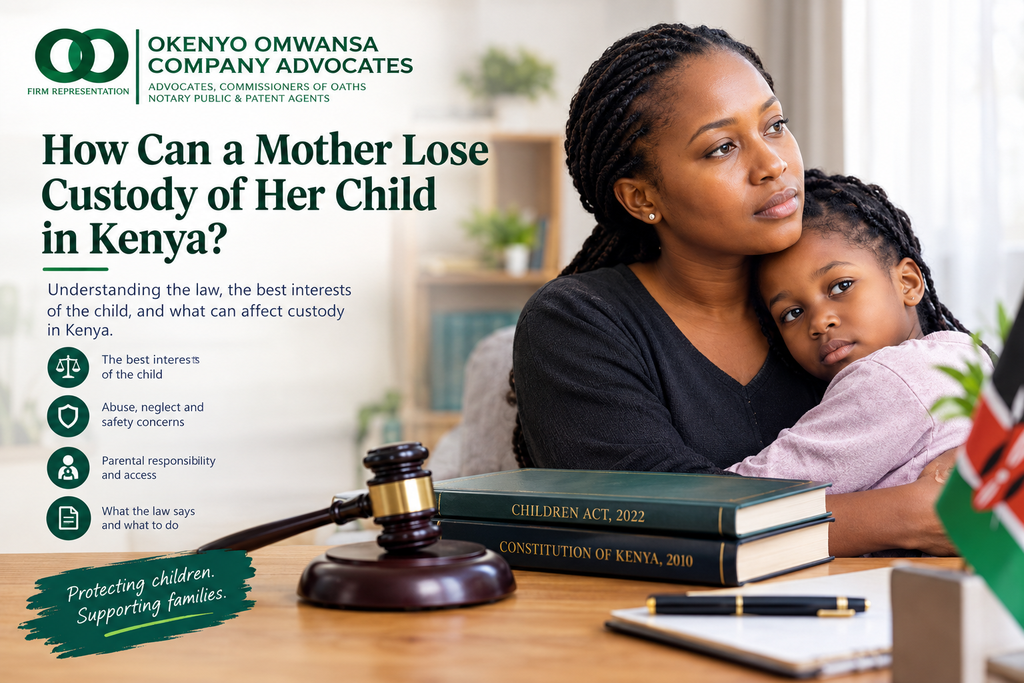
A mother can lose actual custody, care and control of her child in Kenya if a court finds that living with her is not in the child’s best interests.
However, a mother does not lose custody simply because the father earns more money, has a bigger house, remarries, or files a custody case.
Kenyan courts must focus on the best interests of the child. Article 53(2) of the Constitution makes the child’s best interests paramount, while section 8 of the Children Act, 2022 requires the child’s best interests to be the primary consideration in matters concerning children.
The court can consider the mother’s conduct, the child’s wishes where appropriate, the child’s living arrangements, any risk of harm, the ability of each parent to meet the child’s needs and other circumstances affecting the child’s welfare.
In serious cases, the court may give the father actual custody while allowing the mother access or visitation. In other cases, the court may order joint legal custody but place the child’s day-to-day care with the father.
The important point is this:
Custody is not a reward given to the better parent. The court’s central concern is what arrangement protects the child and promotes the child’s welfare.
What does custody mean under Kenyan law?
The Children Act, 2022 distinguishes between different aspects of parental responsibility and custody.
Actual custody concerns the physical possession, care and control of a child. The law therefore allows a court to determine who should have day-to-day care of the child without necessarily removing the other parent’s parental responsibility.
A custody order may be made in favour of a parent or guardian under section 102 of the Children Act.
This distinction matters because a mother can lose actual custody without losing all her rights and responsibilities as a parent.
For example, a court could order that:
- the father has actual custody;
- both parents retain legal parental responsibility;
- the mother has regular visitation;
- the mother spends weekends or school holidays with the child;
- both parents participate in major decisions affecting the child.
A custody dispute therefore does not always end with one parent completely disappearing from the child’s life.
The starting point: the child’s best interests
The most important rule is found in Article 53(2) of the Constitution of Kenya:
A child’s best interests are of paramount importance in every matter concerning the child.
The Children Act, 2022 reinforces that constitutional protection.
Section 8 requires courts and other decision-makers dealing with children to treat the child’s best interests as the primary consideration. The First Schedule to the Act provides additional factors that can guide a best-interests assessment.
Those considerations include matters such as:
- the child’s age and maturity;
- the child’s developmental needs;
- any special needs;
- the child’s relationship with each parent;
- the child’s relationship with other important people;
- the child’s wishes where the child is capable of expressing a meaningful preference;
- the stability of the child’s current home;
- the stability of proposed living arrangements;
- the capacity of each parent to provide love, affection and guidance;
- the child’s physical, emotional and educational needs;
- any history or risk of harm;
- the effect of changing the child’s circumstances.
The court therefore looks at the whole situation, rather than asking which parent is simply more financially comfortable.
Can a mother lose custody because she is a bad parent?
Potentially, yes.
But the phrase “bad parent” is not a legal test.
A court needs evidence showing that the mother’s conduct or circumstances affect the child’s welfare.
For example, serious concerns may arise where there is evidence of:
- physical abuse;
- sexual abuse;
- serious emotional abuse;
- persistent neglect;
- exposing the child to dangerous situations;
- failure to provide basic care;
- abandonment;
- serious substance abuse affecting parenting;
- domestic violence that places the child at risk;
- deliberately exposing the child to harmful people or environments;
- repeated failure to comply with court orders concerning the child.
The Constitution expressly protects children from abuse, neglect, harmful cultural practices, violence, inhuman treatment and hazardous or exploitative labour.
Where evidence establishes that a child is at risk, the court can make orders designed to protect the child.
1. Child abuse can result in loss or restriction of custody
Child abuse is one of the most serious circumstances that can affect custody.
The issue may arise where a mother is accused of:
- physically assaulting the child;
- sexually abusing the child;
- seriously threatening or intimidating the child;
- subjecting the child to severe emotional abuse;
- allowing another person to abuse the child;
- repeatedly exposing the child to violence.
The court’s question is not simply whether an allegation has been made.
It must consider the evidence and determine what arrangement serves the child’s welfare.
Where there is a genuine risk of harm, the court may restrict contact, order supervised access or place actual custody with another person.
2. Serious neglect can affect custody
Neglect can also become a major custody issue.
Examples could include persistent failure to provide:
- adequate food;
- appropriate shelter;
- necessary medical care;
- education;
- supervision;
- basic hygiene;
- protection from dangerous situations.
One difficult period in a mother’s life does not automatically mean that she is neglecting her child.
Courts generally need to consider the circumstances as a whole.
For example, temporary unemployment is not the same as deliberately refusing to care for a child.
Financial difficulty should therefore not automatically be confused with parental unfitness.
3. A mother’s financial position does not automatically determine custody
This is an important misconception.
A father does not automatically obtain custody because he earns more money.
Article 53(1)(e) of the Constitution gives a child the right to parental care and protection, including equal responsibility of the mother and father to provide for the child, whether or not they are married.
The court can therefore distinguish between:
Who has more money?
and
Which arrangement best serves the child’s welfare?
A parent with greater financial resources may still have parental obligations even where the other parent has actual custody.
Conversely, a mother who has limited income may still be the appropriate person to have actual custody if she provides a stable, safe and supportive home.
4. Substance abuse may affect custody where it places the child at risk
Alcohol or drug use does not automatically mean that a mother will lose custody.
The relevant question is whether the substance use affects her ability to care for the child or exposes the child to harm.
For example, concerns may become serious if evidence shows that a mother:
- regularly becomes intoxicated while responsible for the child;
- leaves the child without appropriate supervision;
- spends money needed for the child’s basic needs on substances;
- exposes the child to dangerous individuals or environments;
- drives with the child while intoxicated;
- becomes violent or unpredictable because of substance use.
The court can consider the evidence and determine whether restrictions or a different custody arrangement are necessary.
5. Domestic violence can affect a custody decision
Domestic violence can complicate a custody case considerably.
A parent who repeatedly exposes a child to violence may face serious questions about whether the child’s current living arrangement is safe.
At the same time, the court should distinguish between:
- allegations that have not been proved;
- documented incidents;
- ongoing risks;
- protective orders;
- criminal proceedings;
- evidence from medical professionals, police or other relevant sources.
The central question remains the child’s safety and welfare.
6. Abandoning the child can affect custody
A prolonged failure to maintain contact with a child may become relevant to custody.
The Children Act defines an abandoned child to include a child whose parent, guardian or caregiver has deserted the child or wilfully failed to make contact for more than six months.
However, the circumstances matter.
A mother who temporarily leaves a child because of circumstances beyond her control is not necessarily in the same position as a parent who deliberately abandons the child.
The court will consider the evidence and the reason for the absence.
7. Repeatedly frustrating the father’s lawful access can become a problem
A mother who has custody does not automatically have the right to prevent the father from seeing the child.
The Children Act protects parental responsibility and provides mechanisms for dealing with custody and access.
Where a parent deliberately frustrates a lawful court order or parental responsibility arrangement, the consequences can be serious.
The Children Act provides that a person who, in breach of a parental responsibility agreement or court order, hinders another person from exercising access or parental responsibility, or abducts the child, commits an offence.
That does not mean a mother must hand a child over whenever the father demands it.
If she genuinely believes the child is unsafe, the appropriate response is to seek legal protection or appropriate court orders rather than simply ignoring an existing order.
8. Taking the child away without addressing the legal position can affect custody
Relocation can become particularly important in custody disputes.
For example, a mother may decide to:
- move to another county;
- relocate to another part of Kenya;
- move abroad;
- take the child abroad;
- change the child’s school or residence without consultation.
A relocation decision can affect the child’s relationship with the other parent.
The court may therefore consider:
- why the mother wants to relocate;
- whether the relocation is genuine;
- how far away the child will live;
- how the father will maintain contact;
- whether the move disrupts schooling;
- whether the move is intended to frustrate access;
- whether the relocation benefits or harms the child.
A mother should therefore obtain legal advice before taking a major relocation step where custody is disputed or a court order is already in place.
9. Ignoring a custody order can seriously weaken a mother’s case
Once a court has made a custody, access or parental responsibility order, both parents must comply with it unless it is changed or set aside through the appropriate legal process.
A mother who repeatedly disobeys court orders may give the court grounds to reconsider the existing arrangement.
For example, a serious pattern could involve:
- refusing court-ordered access;
- hiding the child;
- changing residence without complying with the order;
- refusing to return the child after authorised access;
- removing the child from Kenya contrary to an order;
- interfering with the father’s parental responsibility.
The appropriate response to an unfair order is generally to seek its variation or appeal where legally available—not to disregard it.
10. A mother’s new relationship does not automatically mean she loses custody
This is an area where older assumptions can be misleading.
A mother does not automatically lose custody because she remarries or begins a new relationship.
The court should consider whether the new circumstances affect the child’s welfare.
Relevant issues might include:
- the stability of the new household;
- the child’s relationship with the new partner;
- whether the child is safe;
- whether there is violence or abuse;
- the suitability of the living environment;
- whether the child’s emotional and educational needs continue to be met.
Kenyan case law has historically referred to a mother’s new marriage among circumstances that could, depending on the facts, constitute an exceptional circumstance in cases involving young children. However, modern custody decisions must be read alongside the constitutional best-interests principle, rather than treating remarriage as an automatic ground for removing custody.
That distinction is important.
11. A mother’s living conditions can become relevant
The court can consider the stability and suitability of the child’s living arrangements.
That does not mean a mother needs to own a large house.
The question is whether the child has a safe and suitable environment.
Concerns may arise where evidence shows that:
- the child has no stable place to live;
- the environment is dangerous;
- the child lacks basic shelter;
- there are serious sanitation problems;
- the child is repeatedly moved between unstable homes;
- the child is exposed to violence or other dangers.
The First Schedule to the Children Act specifically directs attention to the stability and adequacy of the child’s living arrangements.
12. The child’s wishes may matter
The child’s opinion can be relevant, particularly as the child becomes older and more mature.
Section 8 of the Children Act requires the child’s opinion to be taken into account in appropriate cases, having regard to the child’s age and degree of maturity.
Section 103 also requires the court, when considering a custody order, to consider the ascertainable wishes of the child while taking account of the child’s evolving capacity.
That does not mean an older child can simply choose which parent to live with.
The child’s wishes are one factor among several.
The court must also consider whether those wishes are genuinely the child’s own and whether following them would promote the child’s welfare.
13. The mother may have custody restricted because of a serious risk of harm
The Children Act gives the court a wide range of factors to consider.
Section 103 includes whether the child has suffered harm or is likely to suffer harm if a particular custody order is not made. It also covers the conduct and wishes of the parent, the child’s wishes, existing protective orders, siblings and other matters relevant to the child’s welfare.
This means a custody dispute can turn on risk, not only on something that has already happened.
For example, if evidence demonstrates that a child is likely to suffer serious harm if left in a particular environment, the court may act to protect the child.
Does a mother automatically get custody of a young child in Kenya?
Not automatically.
Kenyan courts have historically recognised a general preference for mothers when dealing with children of tender years, especially where no exceptional circumstances exist.
For example, in KKI & another v DMN [2023] KEHC 1817 (KLR), the High Court discussed the traditional position that custody of young children would ordinarily be granted to the mother unless exceptional circumstances existed. The court also emphasised the best-interests approach under the 2022 Children Act.
However, this is not an absolute rule.
The modern approach requires the court to examine the child’s circumstances and apply the constitutional best-interests principle.
A father therefore does not have to prove that the mother is an unfit human being before seeking custody. He must present evidence supporting the custody arrangement that he says is in the child’s best interests.
What are “exceptional circumstances” in a custody case?
Older Kenyan custody decisions have identified circumstances such as:
- serious instability;
- an unsuitable living environment;
- serious misconduct affecting the child’s welfare;
- conduct exposing the child to harm;
- circumstances making the mother’s care unsuitable.
But courts should not apply these examples mechanically.
The question remains:
What arrangement best protects this particular child?
In MAO v CO [2023] KEHC 113 (KLR), the High Court applied section 103 of the Children Act and considered factors including parental conduct, the child’s wishes, possible harm, the child’s circumstances and the child’s best interests.
Can a father get custody simply because he has more money?
No.
Financial capacity can be relevant because parents have responsibilities to provide for their children.
However, money alone should not decide custody.
A wealthy parent may be able to pay for a better school or larger home, but custody involves much more than financial provision.
The court may consider:
- emotional care;
- stability;
- safety;
- education;
- medical care;
- parental involvement;
- guidance;
- the child’s relationship with each parent;
- the child’s wishes;
- the ability of each parent to meet the child’s overall needs.
Kenyan courts have emphasised that children’s matters should not be reduced to a contest between parental financial resources. The constitutional framework gives both parents responsibility toward the child.
Can a mother lose custody because she works?
Generally, having a job is not a reason to lose custody.
Many parents work while raising children.
The relevant question is whether the mother’s work arrangements allow the child to receive appropriate care and supervision.
A court might examine:
- who looks after the child while she works;
- the child’s school arrangements;
- working hours;
- availability of childcare;
- the stability of the home;
- whether the mother remains involved in the child’s life.
A working mother should not assume that employment itself makes her unsuitable for custody.
Can a mother lose custody because she is unmarried?
Not simply because she is unmarried.
The Constitution gives the child a right to parental care and protection and expressly recognises equal responsibility of the mother and father whether or not they are married to each other.
The court should focus on the child’s welfare rather than treating marital status as an automatic reason to remove custody.
Can a mother lose custody if she has a new boyfriend?
A new relationship by itself is not enough.
The court may become concerned if the relationship creates a genuine risk to the child—for example, where there is evidence of violence, abuse, serious instability or another circumstance that affects the child’s welfare.
The existence of a boyfriend or new partner should therefore be distinguished from evidence that the relationship is harmful to the child.
What happens if the mother is accused of child abuse?
An accusation is not automatically proof.
The court should consider the evidence.
Depending on the circumstances, evidence may include:
- medical records;
- police reports;
- witness statements;
- photographs;
- school records;
- children’s officer reports;
- professional assessments;
- communications;
- previous court orders;
- other relevant evidence.
Where the allegation involves immediate danger, urgent protective orders may become necessary.
A parent facing such allegations should take the matter seriously and obtain legal advice promptly.
Can a mother regain custody after losing it?
Yes, depending on the circumstances.
A custody arrangement is not necessarily permanent until the child turns 18.
If circumstances materially change, a parent may seek appropriate orders concerning custody, access or parental responsibility.
For example, circumstances may change if:
- a previous safety concern has been resolved;
- the mother’s living arrangements have stabilised;
- rehabilitation has occurred;
- the child has developed new needs;
- the existing arrangement is no longer serving the child’s welfare;
- new evidence becomes available.
The court will still apply the child’s best interests when considering the new application.
What evidence can a mother use to defend a custody case?
A mother facing a custody application should focus on evidence rather than simply attacking the father.
Useful evidence may include:
Evidence of stable care
- school records;
- medical records;
- childcare arrangements;
- evidence of regular attendance;
- evidence of the child’s daily routine.
Evidence of a suitable home
- proof of residence;
- photographs where relevant;
- tenancy or ownership documents where appropriate;
- evidence concerning the child’s sleeping and living arrangements.
Evidence of parental involvement
- communication records;
- school involvement;
- medical appointments;
- extracurricular activities;
- evidence of day-to-day care.
Evidence addressing allegations
Where the father makes allegations of abuse, neglect or other misconduct, the mother should gather evidence that directly addresses those allegations.
A custody case should be approached as an evidence-based legal dispute, not merely as a conflict between parents.
What if the father is using custody proceedings to punish the mother?
This can happen in contentious family disputes, but the court will ultimately focus on the child.
A mother should avoid turning the proceedings into a contest about who is the worse spouse.
Issues between former partners matter only to the extent that they affect:
- the child’s welfare;
- parenting;
- safety;
- parental responsibility;
- access;
- the child’s living arrangements.
For example, a father’s failure to be a good husband does not automatically make him an unsuitable father.
Likewise, a mother’s relationship difficulties do not automatically make her an unsuitable mother.
The court must focus on the child.
Joint custody does not necessarily mean equal time
Parents sometimes assume that joint custody means the child must spend exactly 50% of the time with each parent.
That is not necessarily the case.
A court can structure parental responsibility and access according to the child’s circumstances.
For example, one parent may have:
- actual day-to-day custody;
while both parents retain:
- parental responsibility;
- decision-making responsibilities;
- access rights;
- school-holiday arrangements.
In AK v SMM [2023] KEHC 25981 (KLR), the High Court ordered actual custody with one parent while giving both parents joint legal custody and structured access to the other parent.
This illustrates why parents should distinguish actual custody from broader parental responsibility.
What should a mother do if the father threatens to take the child?
Do not respond by hiding the child or ignoring court orders.
Instead:
- Find out whether the father has already filed a case.
- Obtain a copy of any existing court order.
- Document relevant communications.
- Preserve evidence concerning the child’s care and welfare.
- Seek legal advice quickly.
- If there is an immediate safety risk, seek appropriate protective or emergency orders.
- Continue acting in a way that protects the child’s welfare.
If there is already a custody order, the mother should understand exactly what it requires.
What the court looks at in a Kenyan custody dispute
Under section 103 of the Children Act, the court can consider:
| Factor | What it can mean |
|---|---|
| Parent’s conduct | How each parent behaves toward the child and the other parent |
| Parent’s wishes | What each parent proposes for the child |
| Child’s wishes | Relevant according to age and maturity |
| Risk of harm | Whether the child has suffered or may suffer harm |
| Child’s circumstances | Home, education, health and development |
| Siblings | Relationships and arrangements involving siblings |
| Existing orders | Care, supervision, protection or exclusion orders |
| Religion/custom | Relevant circumstances where appropriate |
| Best interests | The overarching consideration |
These factors come from section 103 and must be read together with the constitutional best-interests principle.
A real Kenyan case where custody was given to the father
Kenyan case law demonstrates that a mother can lose actual custody where the evidence supports that outcome.
In one High Court decision, the court found that the welfare of the children required full custody, care and control to be placed with their father while the mother received defined visitation rights. The court considered the circumstances affecting the children’s welfare rather than treating maternal custody as automatic.
The broader lesson is important:
The court can place children with their father where the evidence shows that doing so better protects their welfare.
Does losing custody mean a mother loses parental responsibility?
Not necessarily.
This is an important distinction.
Custody concerns who has care and control of the child.
Parental responsibility is broader. It includes the duties, rights, powers and responsibilities a parent has in relation to the child and the child’s property.
The Children Act recognises parental responsibility for both parents.
Therefore, a court can give the father actual custody while preserving the mother’s parental role and access to the child.
The exact orders depend on the circumstances of the case.
How a mother can protect her custody rights
If a custody dispute has started, a mother should avoid making decisions that could later be used against her.
Keep the child’s routine stable
Where possible, maintain continuity in:
- school;
- healthcare;
- accommodation;
- childcare;
- family relationships.
Keep records
Preserve relevant:
- school records;
- medical records;
- messages;
- court documents;
- agreements;
- receipts;
- communication concerning access.
Do not obstruct lawful access
If the father has lawful access, comply with the order unless there is a genuine safety issue requiring urgent legal intervention.
Do not make unplanned relocation decisions
If relocation will materially affect the father’s access, obtain legal advice before moving the child.
Focus on the child
Avoid using the child as a messenger or encouraging the child to reject the other parent.
Take allegations seriously
If the father alleges abuse, neglect or another serious issue, respond with evidence rather than emotion.
Frequently Asked Questions
Can a mother lose custody of a child in Kenya?
Yes. A court can give actual custody to the father or another suitable person where the evidence shows that this arrangement serves the child’s best interests.
What is the biggest reason a mother can lose custody?
There is no single automatic reason. Serious risks to the child’s welfare—such as abuse, neglect, dangerous living conditions, abandonment or persistent failure to comply with custody orders—can become important factors.
Can a mother lose custody because she is poor?
Not simply because she has limited income. Financial circumstances can be considered as part of the child’s needs, but custody is determined by the child’s overall best interests, not simply which parent has more money.
Can a mother lose custody because she works?
Not automatically. The court can consider whether the child’s needs are adequately met while the mother works.
Can a mother lose custody because she remarries?
Remarriage does not automatically remove custody. The court considers whether the new household and circumstances affect the child’s welfare.
Can a father take custody of a young child from the mother?
Yes, but the fact that a child is young does not by itself determine the outcome. Kenyan courts have recognised a traditional preference for mothers in cases involving children of tender years, subject to exceptional circumstances, while modern decisions emphasise the constitutional best-interests test.
Does the father have equal parental responsibility?
The Constitution provides that parental care and protection include equal responsibility of the mother and father to provide for the child, whether or not they are married.
Can a mother get custody back after losing it?
Potentially, yes. Where circumstances change, a parent may seek appropriate orders, but the court will again consider the child’s best interests.
Final word for mothers facing a custody dispute
The question in a Kenyan custody case is not simply:
“Who is the better parent?”
The court has to determine:
“What arrangement is in this child’s best interests?”
A mother should therefore not assume that she will automatically retain custody because the child is young. At the same time, she should not assume that the father will obtain custody merely because he has more money, a larger house or a lawyer who has filed a case.
Evidence matters.
The child’s safety matters.
Stability matters.
The child’s relationship with both parents matters.
And above all, the child’s best interests remain paramount under Article 53(2) of the Constitution and section 8 of the Children Act, 2022.
For a mother facing a custody application, the best time to obtain legal advice is before making a decision that could affect the child’s residence, schooling, access to the other parent or the existing custody arrangement.
Legal support for child custody matters in Kenya
Okenyo Omwansa & Co. Advocates provides family-law services, including advice and representation in matters involving divorce, custody, maintenance, succession and related family disputes.
The firm’s family-law team includes advocates with experience in family and succession matters, including custody, divorce, maintenance and probate.
Family Law – Okenyo Omwansa & Co. Advocates
For a custody dispute, the legal strategy should focus on the child’s circumstances, the evidence available, existing parental-responsibility arrangements and the specific orders that will protect the child’s welfare.
Suggested related article
- Child Custody in Kenya: How Courts Decide Who Gets Custody
Primary legal sources: Constitution of Kenya, 2010; Children Act, 2022; and decisions of Kenyan courts interpreting the best-interests and custody provisions.