
You have 0 items in your cart
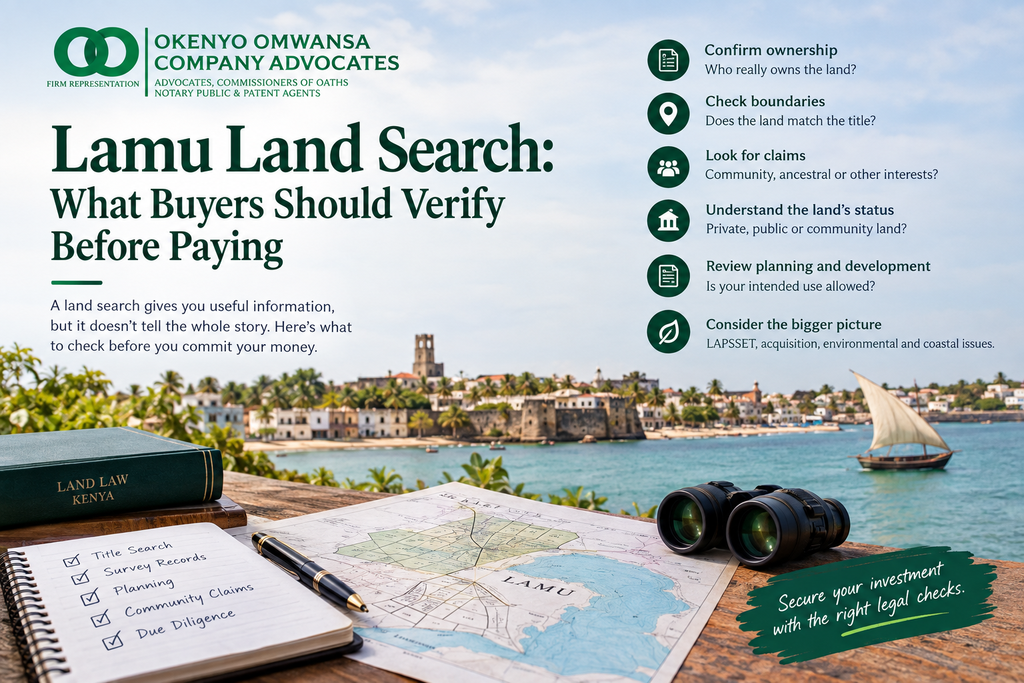
Lamu land search is only the beginning
A land search is one of the first checks a buyer should make before purchasing property in Lamu. It can confirm important information held in the land register, including the registered proprietor and entries such as charges, cautions and restrictions. The State Department for Lands describes the search certificate as an important due-diligence document for land transactions.
But a clean land search does not automatically mean that a Lamu property is safe to buy.
Lamu has particular land issues that can make a simple title search insufficient. Depending on the location, a buyer may need to investigate community or ancestral claims, historical occupation, boundaries, access, planning controls, environmental restrictions, infrastructure projects, compulsory acquisition and pending disputes.
This matters even more around areas affected by major development such as Lamu Port and the LAPSSET Corridor.
The right question is therefore not simply:
“Is the title clean?”
It is:
“Does the seller have the right to sell this particular property, and can I safely acquire, use and develop it after completion?”
That is the purpose of proper land due diligence.
What does a Lamu land search actually tell you?
An official search checks the information recorded against a particular parcel in the land register.
Under section 34 of the Land Registration Act, a person requiring an official search is entitled to obtain particulars of subsisting entries in the register and, subject to the prescribed requirements and fees, certified copies of documents, cadastral maps or plans filed at the registry.
A search may therefore help you establish:
- The registered owner.
- The title or parcel number.
- Registered charges.
- Cautions.
- Restrictions.
- Other registered interests.
- Certain information contained in the land register.
The State Department for Lands currently lists KSh 1,000 as the charge for issuance of a search certificate.
However, the register is only one part of the investigation.
A buyer should combine the search with survey, planning, physical, legal and transaction-level checks.
1. Confirm that the title belongs to the person selling the land
Start with the obvious question:
Who actually owns the property?
The name appearing on the title should correspond with the person or entity selling the property.
If the registered proprietor is an individual, verify the person’s identity documents and compare the details against the land records.
If the registered owner is a company, obtain and review the company’s registration information and establish who has authority to enter into the transaction.
The same applies where someone claims to act under a power of attorney, as an administrator of an estate, as a trustee or on behalf of a family.
Do not assume that because someone possesses an original title deed, that person automatically has authority to sell.
2. Check for charges, cautions and restrictions
One of the most important purposes of a land search is to identify registered interests affecting the property.
For example, the search may reveal:
- A bank charge.
- A caution.
- A restriction.
- Another registered interest.
- A previous transaction that has not been completed.
These entries can affect whether the seller can transfer the property and what must happen before completion.
A buyer should never agree to pay the full purchase price simply because the seller says that an existing charge or restriction will be removed later.
Instead, the sale agreement should clearly explain how and when each encumbrance will be discharged or removed.
3. Verify the parcel on the ground
A title number on a document is not the same thing as knowing exactly which piece of land you are buying.
This is particularly important in areas where development and land values are changing quickly.
A proper survey check should establish matters such as:
- The location of the parcel.
- Its dimensions.
- Boundary position.
- Beacons.
- Access.
- Adjoining parcels.
- Any discrepancy between the title information and the physical position of the land.
The State Department for Lands separately provides land survey searches for official survey records, plans and maps. These can provide information about boundaries, beacons, survey numbers and historical changes to the configuration of a parcel.
That is why a buyer should not rely on a title search alone.
4. Visit the land before paying
This sounds obvious, but it is one of the most important steps.
Visit the property.
Do not rely exclusively on:
- photographs;
- Google Maps;
- a seller’s description;
- an agent’s brochure;
- a beacon certificate;
- or a title deed.
Inspect the land physically.
Look at the neighbouring properties. Speak to people in the surrounding area where appropriate. Identify roads and access routes. Check whether another person is occupying or using the property.
A physical inspection may reveal issues that do not immediately appear on the title search.
For example, you may discover that:
- another person is occupying the land;
- the advertised access road does not actually exist;
- the boundaries on the ground do not match the seller’s description;
- neighbouring users claim an access or other right;
- the property is affected by an existing development;
- the land is being used differently from what the seller represented.
Those findings should be investigated before money changes hands.
5. Ask whether anyone else claims an interest in the land
Lamu requires particular care because land rights can involve more than the registered title.
A buyer should investigate whether there are claims based on:
- ancestral occupation;
- customary interests;
- community land;
- historical occupation;
- family arrangements;
- succession;
- informal settlements;
- access or traditional use.
This does not mean that every Lamu title is defective.
It means that a buyer should not treat registration as the end of the investigation where circumstances on the ground suggest that other interests may exist.
Lamu County has recently undertaken community-land registration work. The broader county planning framework also identifies land-tenure security, surveying, regularisation and titling as continuing land-management priorities.
6. Find out whether the land is private, public or community land
This is one of the most important questions in Lamu land due diligence.
A buyer should establish the legal classification of the land before negotiating the purchase.
Do not assume that every parcel advertised as “private land” is necessarily available for an ordinary private sale.
The investigation should consider:
Private land
The seller must demonstrate a valid registrable interest and authority to transfer it.
Public land
Private individuals cannot simply sell public land as though it were privately owned.
Community land
Different legal rules apply. A buyer needs to establish how the land was registered, who holds the relevant rights and whether the proposed transaction is legally permitted.
This issue becomes particularly important in parts of Lamu where ancestral and community land questions intersect with development.
7. Investigate ancestral and customary claims
A buyer should be cautious where a seller says:
“This has always been our family land.”
That statement may be important, but it does not by itself establish the legal status of the property.
Conversely, the existence of a registered title does not mean a buyer should ignore credible information about historical occupation or competing claims.
The investigation should establish:
- How the land was originally acquired.
- Whether it was previously community or trust land.
- Whether adjudication took place.
- Whether previous owners or occupants challenged the registration.
- Whether there are succession issues.
- Whether there are pending court proceedings.
- Whether local residents claim rights affecting the property.
This is particularly relevant in areas experiencing major infrastructure development.
8. Check whether the property is affected by LAPSSET or other infrastructure plans
This is a major Lamu-specific due-diligence issue.
A property may be advertised as a promising investment because it is “near Lamu Port,” “inside the LAPSSET corridor” or “close to future infrastructure.”
The buyer should not treat those descriptions as automatically positive.
Find out what the actual development plans mean for the specific parcel.
The history of Lamu Port development demonstrates why this matters.
In Kenya Ports Authority v Nightshade Properties Limited & 4 others [2022] KECA 385 (KLR), the Court of Appeal dealt with land in Mokowe, Lamu that had been compulsorily acquired in connection with the LAPSSET project and Lamu Port. The dispute included the question of compensation for the affected property.
The dispute continued through subsequent proceedings, including a 2025 Environment and Land Court matter concerning compensation following the earlier acquisition proceedings.
The lesson for a buyer is straightforward:
Do not buy land near a major infrastructure project without checking whether the parcel itself, its access or its surrounding area may be affected by government plans.
9. Check for compulsory acquisition risk
A land search will not, by itself, answer every question about future government acquisition.
Where a property sits close to major infrastructure, ask whether there are:
- acquisition notices;
- government reservations;
- project plans;
- gazette notices;
- ongoing acquisition processes;
- compensation proceedings;
- disputes concerning the parcel.
Kenyan law provides a statutory framework for compulsory acquisition, including procedures involving the National Land Commission. Courts have repeatedly emphasised the importance of following the statutory process where land is acquired for public purposes.
For a Lamu buyer, this means future acquisition risk deserves a specific investigation rather than a generic title search.
10. Verify the land’s boundaries through survey records
Suppose the seller gives you a title showing 10 acres.
That does not mean you should simply accept the fenced area as the 10 acres described in the title.
A survey professional can help establish whether:
- the beacons are in their proper positions;
- the acreage corresponds with the registered parcel;
- the parcel has been subdivided;
- neighbouring boundaries have shifted;
- an access road cuts through the property;
- the physical occupation corresponds with the survey information.
The State Department for Lands specifically recognises survey searches as a means of obtaining official parcel plans, boundary information and survey records.
11. Verify legal access to the property
A property can have a valid title and still present serious practical problems if the buyer cannot lawfully access it.
Ask:
How do I get to this land?
Then establish whether the access is:
- a public road;
- a registered right of way;
- an easement;
- a private road;
- an informal route;
- or simply land that neighbours currently allow people to cross.
Do not rely on a statement such as:
“Everyone uses this road.”
The transaction should establish the legal basis for access.
This becomes especially important for undeveloped land, agricultural property and investment parcels outside established urban areas.
12. Check the permitted use of the property
Buying land does not mean that you can automatically construct whatever you want on it.
The intended use should be checked against applicable planning controls.
For example, a buyer intending to construct:
- apartments;
- villas;
- a hotel;
- a warehouse;
- shops;
- a commercial centre;
- a tourism facility;
- an industrial development;
may require planning approvals and other regulatory permissions.
The County Government of Lamu has a dedicated land, physical planning and urban-development function and has identified planning, surveying, mapping and development control among its responsibilities.
Therefore, before paying a premium for “development land,” establish whether the proposed development is actually permissible.
13. Do not confuse proximity to Lamu Port with guaranteed appreciation
This is an important investment point.
A seller may tell you:
“The port is coming here.”
Or:
“This land will be worth ten times more when LAPSSET develops.”
Those statements are not legal evidence of future value.
The buyer should independently verify:
- the location of the parcel;
- official planning information;
- existing and proposed infrastructure;
- permitted land use;
- road access;
- utilities;
- surrounding development;
- acquisition plans;
- environmental restrictions.
Never pay a premium solely because someone predicts future infrastructure-driven appreciation.
14. Check whether the property is involved in litigation
Ask the seller directly whether there is any dispute concerning the property.
Then verify the answer independently.
Search for relevant litigation involving:
- the parcel;
- the registered owner;
- previous owners;
- neighbouring parcels;
- access;
- succession;
- compulsory acquisition;
- boundary disputes;
- community claims.
A seller may honestly say that “there is no case against the land” while failing to mention a wider dispute involving the title’s history or an earlier owner.
Legal due diligence should therefore examine the chain of ownership, not just the current owner’s name.
15. Check the seller’s authority where the land belongs to an estate
If the registered owner has died, stop the transaction until the succession position is clear.
A buyer should establish:
- whether probate or letters of administration exist;
- who the lawful administrators are;
- whether the grant has been confirmed where necessary;
- whether the proposed seller has authority to deal with the property;
- whether beneficiaries have relevant rights.
This prevents a common mistake: paying money to a family member who does not legally have authority to sell estate property.
16. Check whether the seller’s documents are genuine
A buyer should not rely on photocopies supplied through WhatsApp or email.
Verify important documents through the relevant official records.
Depending on the transaction, these may include:
- title;
- official search;
- survey documents;
- identification documents;
- company records;
- succession documents;
- powers of attorney;
- land rates information;
- land rent information;
- planning documents;
- consent requirements;
- previous transfer documents.
The government’s Ardhisasa platform provides access to various land-related services, including land registration, land administration, physical planning, survey and mapping, valuation and searches.
However, the availability of an online service does not remove the need for professional verification where the transaction presents legal or factual risks.
17. Check land rates and other outstanding obligations
Before completion, establish whether there are outstanding amounts connected with the property.
Depending on the property and tenure, this may include:
- land rates;
- land rent;
- penalties;
- other statutory obligations.
The sale agreement should make it clear which obligations belong to the seller and which, if any, will become the buyer’s responsibility.
Do not leave these questions until after completion.
18. Check environmental and coastal restrictions
Some Lamu property transactions require more environmental investigation than an ordinary inland residential purchase.
This can be particularly relevant for:
- beachfront property;
- waterfront developments;
- mangrove areas;
- environmentally sensitive locations;
- tourism developments;
- large construction projects;
- land near marine or protected areas.
If your investment depends on constructing a particular development, establish the environmental requirements before purchasing, rather than after acquiring the land.
A cheap parcel can become an expensive mistake if the development you planned cannot obtain the necessary approvals.
19. Confirm what the seller actually owns
Sometimes a seller advertises:
“One acre with beach access.”
The legal parcel may tell a different story.
The buyer should establish exactly what is included in the transaction.
For example:
- Is the beach access legally attached to the property?
- Is there a road reserve?
- Is the seller claiming neighbouring land?
- Are there structures outside the registered boundary?
- Is the advertised acreage the same as the registered acreage?
- Does the seller own the entire parcel?
- Are there tenants or occupants?
The sale agreement should describe the property precisely enough to avoid uncertainty.
20. Do not pay a large deposit before completing due diligence
One of the biggest mistakes buyers make is paying first and investigating later.
The sequence should generally be the opposite:
Identify the property → investigate → negotiate → document the transaction → pay according to agreed completion conditions.
A deposit should not be treated as a substitute for due diligence.
If the seller insists:
“Pay today or someone else will buy it.”
that is a reason to slow down, not speed up.
Pressure is particularly dangerous where the transaction involves a high-value Lamu property marketed as an investment opportunity.
The Lamu land search checklist
Before paying for land in Lamu, a buyer should consider obtaining and verifying at least the following:
Ownership
- Original title or appropriate title documentation reviewed
- Official land search conducted
- Seller’s identity verified
- Seller’s capacity to sell established
- Company records checked where applicable
- Succession documents checked where applicable
Land status
- Private/public/community classification established
- Historical ownership investigated
- Ancestral/customary claims investigated
- Existing occupation investigated
Survey
- Parcel location confirmed
- Boundaries inspected
- Beacons verified
- Survey records checked
- Acreage confirmed
- Access verified
Legal
- Charges checked
- Cautions checked
- Restrictions checked
- Litigation investigated
- Acquisition notices investigated
- Consent requirements identified
Lamu-specific risks
- LAPSSET implications checked
- Lamu Port proximity independently verified
- Infrastructure plans checked
- Community land issues considered
- Coastal restrictions considered where relevant
Development
- Current zoning/use confirmed
- Development permission requirements checked
- Environmental requirements identified
- Roads and utilities investigated
Transaction
- Sale agreement professionally prepared
- Deposit conditions clearly stated
- Completion documents identified
- Encumbrance discharge mechanism agreed
- Transfer process confirmed
Why a clean land search is not enough in Lamu
A clean search is valuable.
It is not the same thing as complete due diligence.
Imagine that the search shows the seller as the registered proprietor and contains no caution or charge.
That answers one important question:
What does the land register currently show?
It does not necessarily answer:
- Where exactly is the parcel?
- Does the boundary match the ground?
- Does another person occupy it?
- Is there a community claim?
- Is access legally secured?
- Is the intended development permitted?
- Is the property affected by infrastructure planning?
- Is there a pending acquisition process?
- Are there environmental restrictions?
- Is the seller’s acquisition history clean?
- Can the buyer obtain the intended approvals?
Those questions can determine whether the property is actually a good purchase.
Why Lamu requires a broader due-diligence approach
Lamu is undergoing significant infrastructure, investment and land-use changes.
The State Department for Lands lists a dedicated Lamu lands office at Lamu Ardhi House, Mokowe Township, with land registration, land administration, land adjudication and settlement, and land survey and mapping functions.
At the same time, Lamu’s planning framework deals with issues such as land-tenure security, settlement planning, surveying, regularisation, zoning and protection of public land.
Major infrastructure has also already generated substantial land and compensation disputes.
For a buyer, that changes the nature of the question.
You are not simply asking:
“Does this title exist?”
You are asking:
“What is the legal, physical, planning and development history of this particular parcel, and what could affect my ownership after I pay?”
That is a much better due-diligence question.
What should you do before paying for Lamu land?
A sensible transaction should follow a clear sequence:
Step 1: Identify the exact parcel
Obtain the title number, location, acreage and seller’s documents.
Step 2: Conduct the official search
Confirm ownership and registered encumbrances.
Step 3: Check survey information
Verify the parcel on the ground and confirm the boundaries.
Step 4: Investigate the history
Look beyond the current title where circumstances require it.
Step 5: Investigate Lamu-specific risks
Check community claims, acquisition, LAPSSET, infrastructure and planning issues.
Step 6: Inspect the property
Confirm occupation, access, boundaries and surrounding use.
Step 7: Confirm development potential
Check the proposed use against planning and environmental requirements.
Step 8: Review the transaction documents
Only after the due-diligence results are satisfactory should the parties proceed to a properly structured sale agreement.
Step 9: Protect the deposit
The agreement should clearly state when money becomes payable, what happens if a material defect is discovered and how existing encumbrances will be dealt with.
Step 10: Complete the transfer properly
The transaction should proceed through the appropriate legal and registration process rather than relying on informal documentation.
Common mistakes when buying land in Lamu
Mistake 1: Relying on the title deed alone
A title is essential, but it is not a substitute for complete due diligence.
Mistake 2: Paying because the land is “near LAPSSET”
Infrastructure proximity does not guarantee development permission, appreciation or absence of acquisition risk.
Mistake 3: Ignoring people occupying the property
An occupied property deserves further investigation before purchase.
Mistake 4: Accepting informal access
A road used by everyone is not necessarily a legally protected right of way.
Mistake 5: Buying community or ancestral land without understanding its status
The legal position should be established before any payment.
Mistake 6: Using an old search
Land records can change. A buyer should obtain current information close to the transaction.
Mistake 7: Paying a deposit before the documents are reviewed
Once substantial money has changed hands, resolving defects can become considerably more difficult.
Mistake 8: Assuming a cheap property is automatically a good investment
The reason for the low price may be the most important thing to investigate.
When should you involve a Lamu land lawyer?
Professional legal due diligence is particularly important where:
- the property has a high purchase price;
- the seller is a company or estate;
- the land is inherited;
- there are occupants;
- the property is near Lamu Port;
- the property is close to major infrastructure;
- community or ancestral claims exist;
- the seller has a power of attorney;
- there are existing encumbrances;
- the property is beachfront or environmentally sensitive;
- you intend to develop a hotel, commercial project or other major facility;
- you are buying from outside Kenya;
- the transaction involves multiple parcels.
A lawyer should not merely tell you whether a search is “clean.” The objective should be to determine whether the entire transaction is legally capable of delivering the property and rights you are paying for.
Final takeaway
A Lamu land search should be treated as the starting point of due diligence, not the end of it.
Before paying for land, a buyer should verify ownership, encumbrances, boundaries, access, land classification, historical claims, occupation, litigation, planning requirements, environmental restrictions and potential government acquisition.
For properties near Lamu Port or the LAPSSET Corridor, the investigation should go further. The legal history of land acquired for the Lamu Port project shows that ownership and compensation issues can become complicated even where major infrastructure is already underway.
The safest approach is simple:
Search the title. Verify the survey. Investigate the history. Inspect the land. Check the planning position. Investigate Lamu-specific risks. Then pay.
Frequently Asked Questions
Is a land search enough when buying land in Lamu?
No. A land search is an important part of due diligence because it reveals information recorded in the land register, including registered ownership and encumbrances. However, buyers should also investigate boundaries, access, land classification, occupation, disputes, planning, environmental matters and possible acquisition risks.
How much does a land search cost in Kenya?
The State Department for Lands currently lists the charge for issuance of a search certificate as KSh 1,000. Government fees can change, so buyers should confirm the current charge before making an application.
Can I buy land near Lamu Port?
Yes, potentially. However, proximity to Lamu Port or LAPSSET should trigger more comprehensive due diligence, not less. Buyers should establish whether the specific parcel is affected by infrastructure plans, acquisition, planning restrictions or existing disputes.
Should I check the survey before buying Lamu land?
Yes. A survey search can provide information about boundaries, beacons, survey numbers and changes to the parcel’s configuration.
Can a clean title still have problems?
Yes. A clean register does not necessarily resolve physical boundary disputes, occupation, access problems, planning restrictions, environmental issues or other matters requiring investigation outside the register.
What is the biggest mistake when buying land in Lamu?
One of the biggest mistakes is paying based on the seller’s representation about the property’s future value or location without independently verifying the parcel, title, boundaries, planning position and development or infrastructure risks.
Legal support for Lamu land transactions
Okenyo Omwansa & Co. Advocates advises clients on real estate and land-related transactions, including property due diligence and conveyancing.
For a Lamu purchase, the objective should be more than confirming that a title exists. The transaction should establish what you are buying, who can sell it, what rights attach to it, what restrictions affect it and whether the property can be used for the purpose you intend.
Real Estate Law – Okenyo Omwansa & Co. Advocates
Related Lamu topics
Primary legal sources: Kenya Law, State Department for Lands, Ardhisasa and County Government of Lamu.